
 ChatQuote
Free job quote template (UK): Word, Excel and PDF
Published October 30, 2026
This free job quote template for UK trades comes in Word, Excel and PDF, with no sign-up and no email address needed: Word template (.docx), Excel template (.xlsx) and PDF to print (.pdf). The Word and PDF files set out the 12 parts of a UK job quote, and the Excel file works out the totals and VAT for you.
A quote is the document your customer decides on, and the one you'll both point at if the job grows. Each part is explained below, with a worked example. The legal and VAT points were checked against GOV.UK, legislation.gov.uk, Citizens Advice and Trading Standards' Business Companion on 29 October 2026.
Key Takeaways
- The template is free in Word, Excel and PDF, with no sign-up.
- A UK job quote should name both parties, describe the work, itemise the price, show VAT status, say how long the price holds and set payment terms.
- Assumptions and exclusions protect your price when a job turns out bigger than it looked.
- If you agree a job with a consumer in their home, or by phone, email or online, they can usually cancel within 14 days, so give them the cancellation information and a cancellation form.
Download the free quote template
- Word template (.docx): fill it in and save it as a PDF to send. It has all 12 parts, a cancellation notice, the model cancellation form and an early-start request for jobs agreed in the customer's home or at a distance.
- Excel template (.xlsx): enter quantities and prices and it calculates the line totals, subtotal, VAT and total, with a switch between "VAT at 20%" and "Not VAT registered". A filled-in example sheet and the cancellation form are included.
- PDF to print (.pdf): print it and fill it in by hand. It has the same contents as the Word file.
- Google Docs: upload the Word file to Google Drive, then open it with Google Docs.
What to include on a UK job quote
A UK job quote should have these 12 parts, in template order:
- Your business details. Name, address, phone and email. A limited company must show its registered number, place of registration, registered office and that it's a limited company on business letters and order forms (gov.uk: signs and stationery). A sole trader using a business name must show their own name and an address for service on business letters and written orders (Companies Act 2006 ss.1200 to 1204). Neither rule mentions quotes, but putting the same details on yours is good practice.
- VAT number, or "Not VAT registered". You must register for VAT if your taxable turnover for the last 12 months goes over £90,000, the threshold since 1 April 2024 (gov.uk: Register for VAT).
- Customer name and job address. The property the price covers.
- Quote number and date. So you both refer to the same version.
- Valid until. The date your price stops holding.
- Job description. Two or three sentences on the work and the finished result.
- Itemised lines. Description, quantity, unit price and line total, with labour and materials on separate lines.
- Assumptions. What you've taken as given, such as access or who buys the tiles.
- Exclusions. What isn't included but could be mistaken for included.
- Subtotal, VAT and total. The standard VAT rate is 20% (gov.uk: VAT rates).
- Timeline. The start date and how long the work takes.
- Payment terms and acceptance. Deposit, stages, due dates, how to pay, and how the customer accepts (signature or written reply).
Parts 8 and 9 protect your price when a job grows.
The 12 parts also answer the checklist Citizens Advice gives homeowners in England before building work: a fixed total rather than a daily rate, a breakdown of work and materials, how long the price is valid, whether VAT is included, when the price can go up (your exclusions say when it can change), and a deposit of no more than 25%.
A filled-in example: bathroom refit quote
The figures in this bathroom refit quote are illustrative, not market prices; the labour lines use an illustrative day rate of £275 (how to work out your day rate shows where a figure like that comes from).
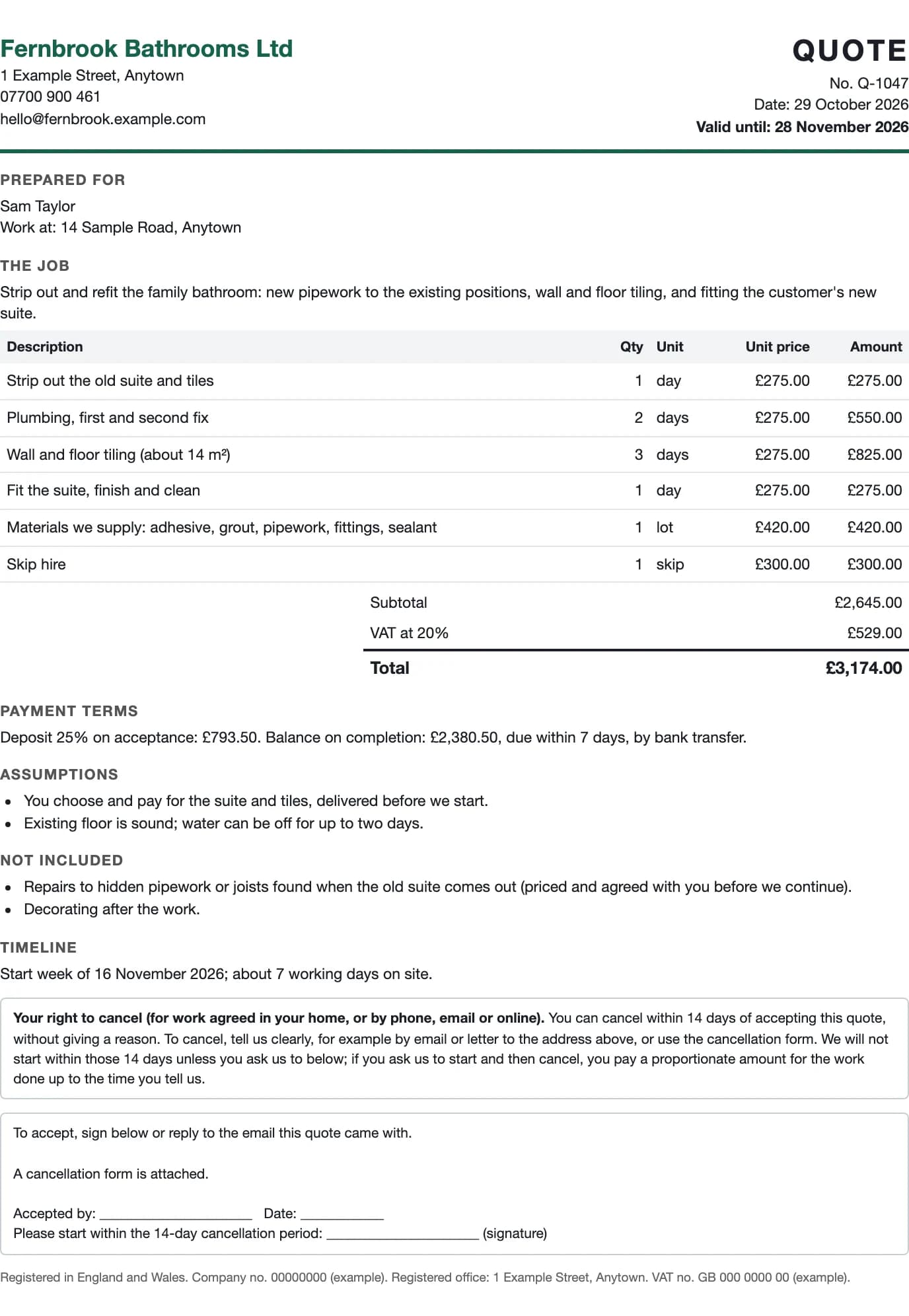
The same example laid out as a finished quote, with the VAT-registered totals. The business and its details are fictional.
Job description: Strip out and refit a bathroom with a new suite, plumbing and tiling.
| Line | Quantity | Unit price | Total |
|---|---|---|---|
| Strip out the old suite and tiles | 1 day | £275.00 | £275.00 |
| Plumbing, first and second fix | 2 days | £275.00 | £550.00 |
| Wall and floor tiling | 3 days | £275.00 | £825.00 |
| Fit the suite, finish and clean | 1 day | £275.00 | £275.00 |
| Materials we supply (adhesive, grout, pipework, fittings, sealant) | 1 | £420.00 | £420.00 |
| Skip hire | 1 | £300.00 | £300.00 |
| Subtotal | £2,645.00 |
The totals depend on whether you're VAT registered. A sole trader whose taxable turnover stays under the £90,000 registration threshold, and who hasn't registered voluntarily, uses the first column:
| Totals | Not VAT registered | VAT registered |
|---|---|---|
| Subtotal | £2,645.00 | £2,645.00 |
| VAT at 20% | Not charged | £529.00 |
| Total | £2,645.00 | £3,174.00 |
| Deposit (25%) | £661.25 | £793.50 |
| Balance | £1,983.75 | £2,380.50 |
- Assumptions: Client chooses and pays for the tiles and the new suite.
- Exclusions: Any hidden pipework repairs found when the old suite is removed; priced separately before work continues.
- Valid until: 28 November 2026, 30 days from the quote date.
- Timeline: Seven working days from an agreed start date.
- Payment terms: 25% deposit on acceptance; balance on completion, due within 7 days, by bank transfer.
Quote or estimate: which are you sending?
A quote is a fixed price for defined work; an estimate is your best guess at the cost. Say on the document which one you're sending.
Trading Standards' Business Companion says an accepted home-improvement quotation is likely to form a binding contract, while "an estimate is not usually deemed to be an offer".
Under the Consumer Rights Act 2015, a consumer pays a reasonable price and no more where no price is fixed. The Act also treats what you say or write about the service beforehand as a term of the contract if the customer takes it into account. Write your description, assumptions and timeline with that in mind.
Rules that change your quote
Two UK rules apply only to some jobs. This is general information, not legal advice; for your own case, check gov.uk or a solicitor.
Jobs agreed in the customer's home, or by phone, email or online
Agree a job with a consumer in their home and it's an off-premises contract. Agree it entirely by phone, email or online and it can be a distance contract. Part 3 of the Consumer Contracts Regulations 2013 gives the customer the same right to cancel in both cases:
- The customer can cancel within 14 days of agreeing the contract, without giving a reason.
- They can cancel with the model cancellation form or with any other clear statement, such as an email (regulation 32). Don't insist on a particular method.
- For a job agreed in their home, you must give them the cancellation information and a cancellation form before they're bound, on paper or, if they agree, by email or another durable medium (regulation 10).
- If you don't give them the cancellation information, the 14 days can run on for up to 12 months longer.
- You can start within the 14 days only if they expressly ask you to. For a job agreed in their home, that request must be on paper or another durable medium such as email (regulation 36).
- If they cancel after asking you to start, they pay a proportionate amount for the work done. If you didn't give them the cancellation information, they pay nothing for it (also regulation 36).
Off-premises contracts where the customer pays £42 or less fall outside these rules (regulation 27). The Word and PDF templates include a cancellation notice, the model cancellation form and a line the customer can sign to ask you to start within 14 days.
Business customers who pay late
If a business pays you late, you can charge statutory interest at 8% plus the Bank of England base rate, unless your contract sets another rate (gov.uk: charging interest). You can also claim fixed debt recovery costs of £40, £70 or £100, depending on the size of the debt (gov.uk: claim debt recovery costs). These rules apply between businesses only. On a quote to a business customer, put the payment due date in your payment terms and say that late payments carry statutory interest.
Adapting the template for your trade
Each trade adds a few standard lines or exclusions to the 12 parts.
- Builders: give skip hire its own line and say whether making good is included.
- Electricians: list certification and testing so the customer sees it's in the price.
- Painters and decorators: state the preparation, the number of coats and who supplies the paint.
- Roofers: price access and scaffolding as separate lines.
- Cleaning services: say how often you'll clean, and add any premium for the first clean.
- Web agencies: price days at your day rate, and exclude content and hosting unless you supply them.
Common quoting mistakes
Each of these gaps can cost you money after the customer says yes.
- No "valid until" date. The customer can come back months later expecting the old price. Give every quote an end date.
- One lump sum. The customer can't see what they're paying for. Itemise labour and materials.
- Unclear VAT. Show it the same way on the quote and invoice, or write "Not VAT registered".
- No exclusions. If the customer mentioned the skirting boards and your quote is silent, they'll assume you're doing them. List what isn't included, in plain words.
- No deposit or payment stages. You fund the job yourself. Set a deposit and dated stage payments.
When a template stops being enough
A template works until quoting eats your evenings or enquiries wait days for a price.
This article is by the makers of ChatQuote, AI quoting software from CodeLeap. An assistant on your website asks each person who enquires the questions you'd ask, then drafts an itemised quote and a branded proposal from your own prices. By default you review them before anything goes out. The quotes it drafts use the same core parts as this template: itemised lines, VAT, assumptions, exclusions, a timeline and payment terms. There's a 30-day free trial, and no card is needed. See how it differs from a standard quote request form, or compare quoting software for UK trades.
Frequently asked questions
Is a quote legally binding in the UK?
For home-improvement work, usually yes, once the customer accepts it. Business Companion says an accepted home-improvement quotation is likely to form a binding contract; an estimate usually isn't an offer.
How long should a quote be valid for?
Long enough for the customer to decide, and short enough that your costs won't move. There's no legal minimum; the example above uses 30 days. Put a "valid until" date on it and send a new quote if they come back later.
Should a quote include VAT?
Yes, if you're registered: show the subtotal, VAT and total. The standard rate is 20% (gov.uk: VAT rates). If you're not, write "Not VAT registered" so the customer knows none will be added.
Can I charge more than my quote?
Plan on holding the price for the work you quoted, because an accepted quote usually forms a contract (Business Companion). If the scope changes, agree the extra price in writing before you do the extra work. Your exclusions should name anything that would be priced separately.
Your next step
Download the Word, Excel or PDF file above, fill in the 12 parts and set a "valid until" date before you send it. For the steps that come before the quote, read the step-by-step guide to quoting a job.
About this guide
Written by the ChatQuote team at CodeLeap Ltd, the company that makes ChatQuote. More guides to quoting and pricing. Spotted something out of date? Email support@chatquote.app.