
 ChatQuote
Accountant fees UK 2026: what small businesses pay
Pricing · Published November 11, 2026
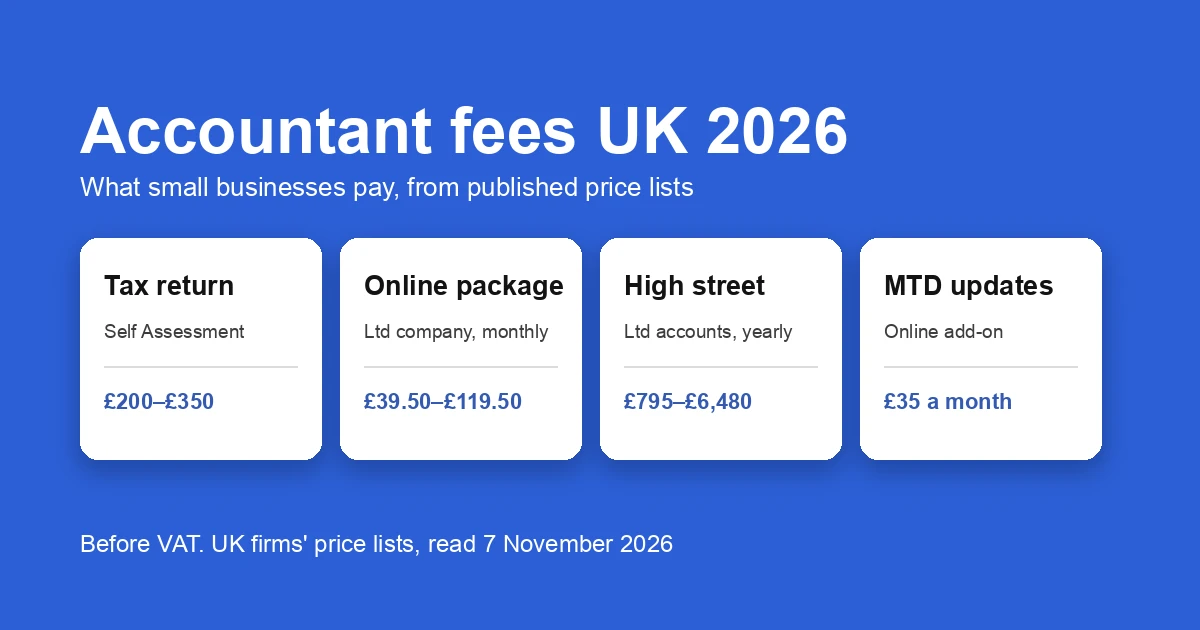
A UK accountant charges about £200 to £350 for a one-off Self Assessment return, and £24.50 to £89.50 a month for an online sole trader package. A small limited company pays from about £40 a month online to £795 to £6,480 a year at a high-street firm, by turnover, for its accounts and Company Tax Return. Those figures come from four UK firms' published price lists, read on 7 November 2026, and all are before VAT. A 2024 survey of practices by the software company IRIS points the same way: 90% of the accountants who answered charged £126 to £400 for a tax return.
Key Takeaways
- A basic Self Assessment return costs £200 to £350 at three firms' published prices (read 7 November 2026, before VAT). IRIS's 2024 practice survey found 90% of respondents charged £126 to £400.
- Limited company accounts and the Company Tax Return cost from £39.50 a month online (The Accountancy Partnership). A high-street firm (Jackson Stapleton) charges £795 to £6,480 a year for the accounts, by turnover.
- Making Tax Digital for Income Tax is compulsory from 6 April 2026 for sole traders and landlords with qualifying income over £50,000. One online firm prices the quarterly updates at £35 a month.
- "Accountant" isn't a protected title. Check membership of ICAEW, ACCA, AAT or another body, and get the fee basis in writing.
- A VAT-registered accountant adds 20% to every fee, so compare prices on the same VAT basis.
What accountants charge in 2026, by service
Accountants price most compliance work as a fixed fee, set by your turnover, how many transactions you have and which returns you need. Hourly rates are kept for advice and one-off work. The table puts four UK firms' published prices side by side. All four say their prices exclude VAT, and all were read on 7 November 2026.
| Service | The Accountancy Partnership (online, a month) | ST Accountancy (a month) | Doshi Accountants (a year) | Jackson Stapleton (high street) |
|---|---|---|---|---|
| Self Assessment return | Included in the sole trader package; £10 for up to 2 company directors | £350 one-off for a sole trader; £25 per director | £200 (income up to £79,000) to £300 (£125,000 and over) | £340, plus £90 per rental property |
| Sole trader accounts and return | £24.50 (turnover up to £20,000) to £89.50 (£400,001 to £500,000) | Not listed | £750 (up to £90,000) to £1,850 (£750,000 to £999,000) | £650 to £1,370 for a profit and loss account and balance sheet (turnover under £50,000) |
| Limited company accounts and Company Tax Return | £39.50 (up to £20,000) to £119.50 (£400,001 to £500,000) | Annual accounts from £50 (turnover up to £10,000) | £900 (up to £90,000) to £2,050 (£750,000 to £999,000) | Accounts £795 to £1,730 (under £60,000) and £2,450 to £6,480 (£100,001 to £250,000); tax return charged on time spent |
| Payroll | £24 for 1 to 4 payslips | £10 for 1 employee | £375 for a monthly payroll of 1 to 5 staff | £40 a run for directors only, plus £255 at year end (under 5 staff) |
| VAT returns | £35 | From £50 (up to 50 transactions a month) | £550 (turnover up to £99,000) | Charged on time spent |
| Bookkeeping | £20 for up to 40 transactions, then 50p each | £35 (up to 50 transactions) | £13.50 an hour, or a fixed monthly fee | Charged on time spent |
| Confirmation statement | Filed "if needed" within the package | Not listed | £96 | £160, plus the £50 filing fee |
| Making Tax Digital quarterly updates | £35 | Not listed | Not listed | Not listed |
Sources: The Accountancy Partnership pricing, ST Accountancy price list, Doshi Accountants fees and Jackson Stapleton price list, all read 7 November 2026.
These are four firms, not the market. The Accountancy Partnership is an online firm whose prices are "per month and exclude VAT". Jackson Stapleton is a high-street practice with offices across Lincolnshire and Nottinghamshire. Doshi lists hourly advice rates of £100 for an accountant to £250 for a partner. None of the four dates its price list, so we've given the date we read each one.
Two other sources give ranges rather than price lists, and their methods differ.
| Source | What it found | Method and date |
|---|---|---|
| IRIS Software Group survey | 90% of accountants charged £126 to £400 for a tax return, and 1% more than £600. 78% charged £500 to £1,000 for a set of accounts. 84% charged £25 to £40 an hour for bookkeeping. | Anonymous poll of UK accountants, February to March 2024, published 14 May 2024. It doesn't give the number of respondents or say whether fees include VAT. |
| Unbiased | Sole trader £50 to £150 a month; limited company £200 to £400 a month; Self Assessment return £150 to £600 | Consumer guide by a finance journalist, updated 23 July 2026. It doesn't state a method or a VAT basis. |
The published price lists mostly sit at or below the guide's ranges. The Accountancy Partnership's limited company package tops out at £119.50 a month for turnover up to £500,000, well under Unbiased's £200 to £400. Our reading, not any source's, is that the guide's ranges describe a fuller service with more advice. Online packages assume you keep your own books in their software.
What each service involves, and the deadlines behind it
Most of what you pay an accountant for is a filing with a legal deadline. Knowing the deadline tells you what a late or missing filing costs, which is the other side of the fee.
Self Assessment tax return
Sole traders, landlords and business partners, among others, file a Self Assessment return each year. For the 2025 to 2026 tax year, an online return and any tax owed are due by 31 January 2027; a paper return by 31 October 2026, which has now passed (GOV.UK deadlines). A late return gets an initial £100 penalty, then £10 a day after three months, up to £900 (GOV.UK penalties).
A return with one source of income is the cheapest. Rental properties, capital gains and foreign income add pages, and firms charge for them: Jackson Stapleton adds £90 per rental property and per supplementary page.
Sole trader and landlord accounts
A sole trader's "accounts" are usually a profit and loss account that feeds the return. Fees rise with turnover. Doshi charges £750 a year for accounts and the return up to £90,000 of turnover. Jackson Stapleton charges £360 to £1,080 for a profit and loss account alone under £50,000, and £650 to £1,370 with a balance sheet. Doshi also lists property accounts, at £150 for one property up to £550 for five.
Limited company accounts and Company Tax Return
A limited company files annual accounts with Companies House within 9 months of its year end, or within 21 months of registering for its first accounts. It sends a Company Tax Return to HMRC within 12 months, and pays its Corporation Tax 9 months and 1 day after the year end (GOV.UK). Late accounts cost a private company £150 if up to a month late, rising to £1,500 after six months. The penalty doubles if it happens two years running (GOV.UK).
This is usually the largest single fee. At Doshi, accounts with the tax return cost £900 a year up to £90,000 of turnover. At Jackson Stapleton, accounts alone cost £795 to £1,730 under £60,000, first-year accounts are at least £1,150, and the tax return is charged on time spent.
Payroll
An employer reports pay and deductions to HMRC in a Full Payment Submission "on or before your employees' payday" (GOV.UK). A company paying its directors a salary runs a payroll too, which is why price lists include a directors-only rate. Firms price it per payslip, per run or per year: £24 a month for up to four payslips online, or £40 a run for directors only at the high-street firm.
VAT returns
Once taxable turnover goes over £90,000 in 12 months, a business must register for VAT (GOV.UK). Returns are usually quarterly, due one calendar month and 7 days after the period ends (GOV.UK). The three published prices are £35 a month online (£420 a year), from £50 a month at ST Accountancy, and £550 a year at Doshi up to £99,000 of turnover. Jackson Stapleton charges on time spent.
Bookkeeping
Bookkeeping is recording each sale, purchase and bank transaction. It's the part you can most easily do yourself, and the one that varies most in price. Firms price it by transaction volume (£20 for up to 40 a month at The Accountancy Partnership) or by the hour (£13.50 at Doshi). IRIS's survey found most respondents charged £25 to £40 an hour.
Confirmation statement
Every company files a confirmation statement at least once every 12 months, within 14 days of the end of its review period (GOV.UK). Companies House charges £50 to file it online and £110 on paper. That fee has risen twice: from £13 to £34 on 1 May 2024 (Companies House annual report 2024 to 2025), then to £50 on 1 February 2026 (GOV.UK). An accountant's charge for filing it comes on top: £96 at Doshi, £160 at Jackson Stapleton.
Making Tax Digital for Income Tax: what it adds to the bill
Making Tax Digital (MTD) for Income Tax started on 6 April 2026. Sole traders and landlords must use it if their qualifying income from self-employment and property was over £50,000 in the 2024 to 2025 tax year. The threshold falls to £30,000 from 6 April 2027 and £20,000 from 6 April 2028 (GOV.UK). HMRC put the first group at 864,000 people in a press release of 5 February 2026.
You keep digital records in compatible software and send a quarterly update of income and expenses. For a standard tax year, updates are due on 7 August, 7 November, 7 February and 7 May (GOV.UK). HMRC's February press release calls the updates "not extra tax returns": you still file a return after the final update. HMRC won't give penalty points for late quarterly updates in 2026 to 2027. From 2027 to 2028, each missed update earns a point, and four points bring a £200 penalty (GOV.UK quarterly updates).
For fees, MTD turns a once-a-year job into five filings. Firms are pricing it as an add-on:
- The Accountancy Partnership charges £35 a month for MTD quarterly updates. For a sole trader with £60,000 turnover, that takes its package from £29.50 to £64.50 a month, or from £354 to £774 a year before VAT.
- In a TaxCalc survey of 215 accountancy professionals in autumn 2025, 47% said they planned to raise prices for MTD clients (ByteStart, 24 February 2026). TaxCalc sells tax software to accountants.
If you keep your own records in MTD software, ask whether the firm will just check and submit your updates. That's less work for them than doing the bookkeeping.
What drives the fee
An accountant's fee follows the time the work takes, and the price lists above show which inputs they use to estimate it.
- Turnover. Every list above tiers its main fee by turnover. A bigger business usually means more transactions and more to check.
- Transactions. ST Accountancy prices bookkeeping, VAT and management accounts by monthly transaction bands, from up to 50 to up to 500.
- Business structure. A limited company needs accounts in a set format, a Company Tax Return and a confirmation statement, so it costs more than a sole trader with the same turnover.
- Which returns you need. VAT, payroll, MTD updates and each director's Self Assessment are usually priced as add-ons.
- Your records. Software with bank feeds is cheaper to work with than a box of receipts. Online firms build their prices on it.
- Who does the work. Doshi's staff hourly rates (bookkeeping is priced separately) run from £25 for clerical work to £250 for a partner, so the same job costs more if a partner does it.
- VAT. A firm registered for VAT adds 20% to its fees. A VAT-registered business can usually reclaim it; a landlord or a small sole trader under the threshold usually can't.
Worked example: one company, three price lists
This example is illustrative: the company is made up, but the prices are each firm's published prices on 7 November 2026, before VAT. The company has a £120,000 turnover and is registered for VAT, filing quarterly. It has two directors on a monthly payroll and no other staff, and keeps its own books in software. Each director's income is under £79,000.
| Service | The Accountancy Partnership | Doshi Accountants | Jackson Stapleton |
|---|---|---|---|
| Accounts and Company Tax Return | £894 (£74.50 × 12) | £1,150 | £2,450 to £6,480, plus time for the tax return |
| Two directors' Self Assessment | £120 (£10 × 12) | £400 (£200 × 2) | £680 (£340 × 2) |
| VAT returns | £420 (£35 × 12) | £750 | Time spent |
| Directors' payroll | £288 (£24 × 12) | £375 | £735 (£40 × 12, plus £255 at year end) |
| Confirmation statement | Included "if needed" | £96 | £160 |
| Total a year, before VAT | £1,722 | £2,771 | From £4,025, plus time-based items |
| Including VAT at 20% | £2,066.40 | £3,325.20 | From £4,830 |
Add the £50 Companies House fee for the confirmation statement in each case. The totals differ by more than double, but so does the service. The online package assumes you use its software and talk to the team online. The high-street firm charges more of its work on time spent and has offices you can visit. Compare what's included, as well as the total.
Qualified or not, and what the engagement letter should say
Anyone in the UK can call themselves an accountant. The law firm Kingsley Napley noted in 2020 that there is "no statutory protection of the title 'accountant'". A firm may describe itself as "chartered accountants" only under ICAEW's regulations (ICAEW helpsheet, updated 5 October 2026). You can check an ICAEW member in ICAEW's online directory; ACCA, AAT and other bodies keep their own registers.
Accountancy firms must be supervised for anti-money laundering. GOV.UK says a firm must register with HMRC unless a professional body already supervises it, or all its clients are supervised themselves. Its list of those bodies includes ICAEW, ICAS, ACCA, CIMA, AAT and the Institute of Certified Bookkeepers (GOV.UK). Asking "who supervises you?" is a quick check.
Qualified accountants have written rules on fees:
- ACCA tells its practitioners "Letters of engagement are mandatory". The letter sets out the work and "the basis on which the fees will be charged" (ACCA).
- ICAEW's Code of Ethics, at R330.5, says a professional accountant "shall provide fee quotes or details of the basis of fees in writing". That should come before the work starts, or as soon as possible after (ICAEW helpsheet, updated 2025).
Whoever you hire, the engagement letter should state:
- Each service included, by name: accounts, which tax returns, payroll, VAT, MTD updates, the confirmation statement.
- The fee for each, whether it's fixed or charged on time, and whether VAT is on top.
- What's excluded and how extra work is priced, such as HMRC enquiries, late records or a new rental property.
- What you must supply, and by when.
- When the fee is reviewed, and how much notice you'll get of a rise.
For a template with these clauses, see our letter of engagement template.
How accounting firms price these services
This section is for practices. All four price lists above are built the same way: a fixed fee set by a few inputs the client can answer before the first call. For the method behind fixed fees and packages across services firms, see how to price professional services.
Fixed monthly packages
A monthly package spreads the year-end work into an even payment, and makes the cost easy to compare. The Accountancy Partnership publishes one table for sole traders, limited companies, partnerships and LLPs, then adds services on top. The package needs a written scope, so the client knows a new rental property or a VAT registration changes the price.
Tiering by turnover and transactions
Turnover is the tier most clients can answer at once. Transactions predict the work better, which is why ST Accountancy uses them for bookkeeping and VAT. Many firms use both: turnover for the year-end fee, transactions for the monthly work.
To set the tiers, start from the hours. The table below is illustrative: the hours and the £80 hourly rate are made up for the example, not market data. It prices a limited company with turnover up to £90,000, one director on payroll and up to 40 transactions a month in the client's own software.
| Work | Hours a year | At £80 an hour |
|---|---|---|
| Year-end accounts | 5 | £400 |
| Company Tax Return | 1.5 | £120 |
| Director's Self Assessment | 1.5 | £120 |
| Confirmation statement | 0.5 | £40 |
| Director's payroll, 12 runs | 3 | £240 |
| Queries and reminders through the year | 3 | £240 |
| Total | 14.5 | £1,160 |
| A month, before VAT | £96.67 | |
| A month, including VAT | £116 |
A firm might publish this as "from £97 a month plus VAT" for that tier, with VAT returns and bookkeeping as add-ons. That sits above The Accountancy Partnership's £39.50 to £54.50 across the same turnover range, and above Doshi's £900 a year (£75 a month) for accounts and the tax return alone, before its add-ons.
Online quote calculators
Some firms put the inputs on the page. ST Accountancy shows a full price grid without asking for contact details. The Accountancy Partnership's instant quote asks for business type, turnover, MTD, VAT, payroll, pensions and bookkeeping. A calculator answers "roughly how much?" at the moment the client asks. It works best when it asks the same questions your engagement letter will price.
Keeping a published "from" price honest
A "from" price should be what a real, defined client pays. Name the client it applies to: the structure, turnover band and returns included. Three rules apply:
- Consumers see the total price. The CMA's price transparency guidance (CMA209) says the total price should include charges "consumers cannot avoid", including taxes such as VAT (CMA summary, updated 7 January 2026). It applies when you sell to consumers, such as an individual who wants a tax return done. Where the price depends on the client's needs, give them what they need to work it out.
- Fixed prices must be available before the contract. Regulation 8(1)(l) of the Provision of Services Regulations 2009 requires the price of a service "where a price is pre-determined". If it isn't, regulation 9 requires the method of calculating it, or a detailed estimate, on request.
- The fee basis goes in writing. ICAEW's R330.5 and ACCA's engagement letter rule, above.
Putting a ballpark on your own site
When a prospect asks "how much would you charge me?", a practice can answer with a range. It works the range out from its own price list and a few scoping answers. The formal fee follows in the engagement letter. Our guide on quotes, estimates and ballparks explains what each one commits you to.
We make ChatQuote, an assistant for your website that asks those scoping questions. If you switch it on, it gives a labelled, non-binding ballpark from your own fee schedule. It then drafts a quote for your team to approve before anything is sent. See how a website chatbot that gives a price works, or read where else AI fits in an accounting practice.
Frequently asked questions
How much does an accountant cost per month in the UK?
The Accountancy Partnership's online packages start at £24.50 a month for a sole trader and £39.50 for a limited company, before VAT. Both are for turnover up to £20,000 (read 7 November 2026). Unbiased's July 2026 guide puts a sole trader at £50 to £150 a month and a limited company at £200 to £400.
How much does an accountant charge for a small limited company?
For accounts and the Company Tax Return with turnover up to £90,000, The Accountancy Partnership charges £474 to £654 a year (£39.50 to £54.50 a month). Doshi Accountants charges £900. At Jackson Stapleton, accounts alone cost £795 to £1,730 under £60,000. Payroll, VAT returns and directors' Self Assessment returns usually cost extra.
Is it worth getting an accountant for Self Assessment?
You don't have to use one. HMRC accepts returns you file yourself. A return with one income source is often simple; rental income, capital gains or MTD records add work and risk. A return costs £200 to £350 at the firms above, against a £100 penalty for filing late.
Are accountant fees tax deductible?
For sole traders, GOV.UK says accountancy fees "can count as allowable business expenses" if they're for business reasons. You can't claim "the cost of preparing and submitting your Self Assessment tax return" (GOV.UK). Companies should check with their accountant.
About this article
Written by the ChatQuote team at CodeLeap Ltd, the company that makes ChatQuote. Prices come from four UK firms' published price lists, a practice survey and a consumer guide. The rules come from GOV.UK, Companies House, the CMA, ICAEW, ACCA and legislation.gov.uk. We read all of them on 7 November 2026. They are not ChatQuote data, and we have no link with the firms named. The worked examples use a made-up company and made-up hours, labelled as illustrative. Firms change their prices, so check the current list before you compare. This is general information, not tax, accounting or legal advice. Spotted something out of date? Email support@chatquote.app.