
 ChatQuote
Conveyancing quotes: what's included and how firms quote
Pricing · Published November 11, 2026
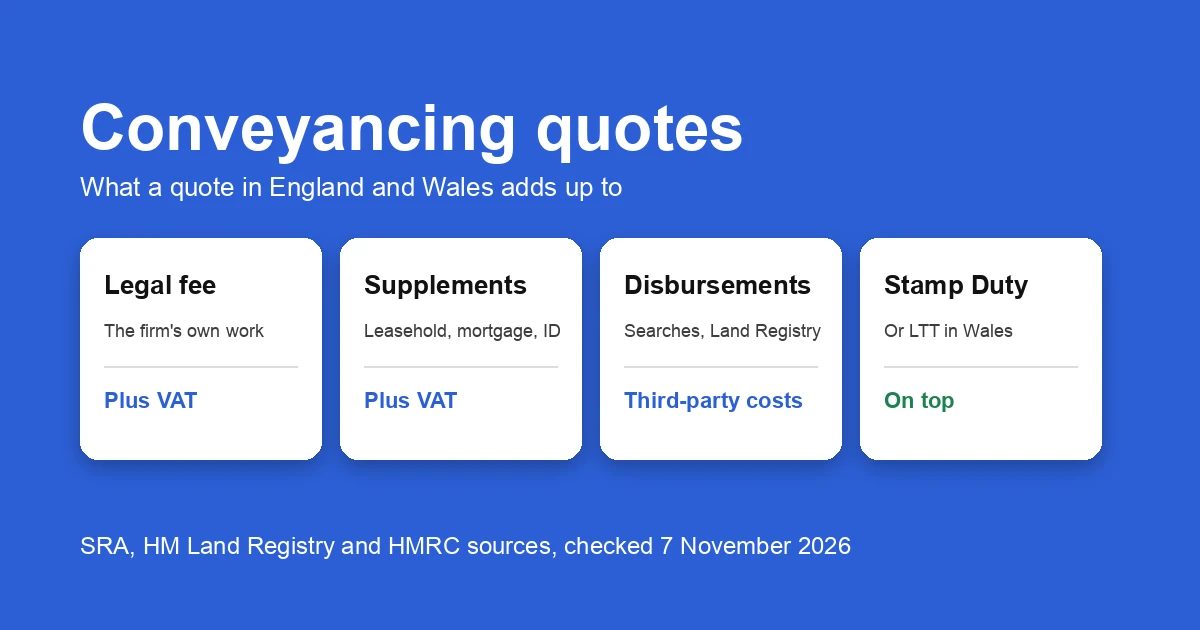
A conveyancing quote for buying a home in England or Wales has four parts: the legal fee, supplements for extra work, disbursements paid to third parties, and VAT. Stamp Duty Land Tax (in England) or Land Transaction Tax (in Wales) sits on top. reallymoving's index puts the average purchase in Q2 2026 at £1,509, including disbursements and expenses. Other published averages for a purchase run from £1,421 to £1,624, but their sources don't say whether those include disbursements or VAT, so the table below shows each with what it counts.
This article breaks a quote into its parts, prices each one from its primary source, and works through a £300,000 purchase. It then explains fixed fees, "no sale, no fee" and referral fees, and lists the red flags in a cheap quote. The last section is for conveyancing firms: what the Solicitors Regulation Authority (SRA) requires you to publish, and how to quote online without hiding the disbursements.
It covers England and Wales only. Scotland and Northern Ireland have different legal systems and conveyancing processes; Scotland also has its own tax. We read every source on 7 November 2026. This is general information, not legal or tax advice.
Key Takeaways
- A conveyancing quote is the legal fee, plus supplements (leasehold, new build, mortgage, Help to Buy or shared ownership, ID checks, bank transfers), plus disbursements (searches, Land Registry fee), plus VAT. Stamp Duty or Land Transaction Tax comes on top.
- reallymoving's index of over 82,000 quotes put the average purchase at £1,509 including disbursements in Q2 2026. Which? and Compare My Move give different figures because they measure different things.
- On a £300,000 purchase in England, Stamp Duty is £5,000 if you aren't buying an additional home, or £0 for a first-time buyer. HM Land Registry's fee is £150 if the conveyancer applies through its portal.
- Compare quotes on the estimated total, not the headline legal fee. Ask what's excluded, whether VAT is shown, and whether anyone is paid a referral fee.
- SRA-regulated firms that offer residential conveyancing must publish their prices on their website, including likely disbursements and VAT. An online quote calculator must give a price without anyone from the firm calling first.
What a conveyancing quote includes
A full quote separates the firm's own charges from money it pays to others for you. The SRA's price transparency guidance (updated 30 September 2024) gives firms a template in this shape. It lists the conveyancer's fees and VAT, then disbursements, then an "estimated total" that excludes Stamp Duty or Land Transaction Tax.
| Part of the quote | What it pays for | VAT? |
|---|---|---|
| Legal fee | The conveyancer's work: checking the title and contract, raising enquiries, reporting to you, exchange, completion and registration | Yes, if the firm is VAT-registered |
| Supplements | Extra work for leasehold, new build, a mortgage lender, Help to Buy or shared ownership, ID checks and bank transfers | Yes, as part of the firm's fees |
| Disbursements | Third-party costs the firm pays for you: property searches, the HM Land Registry fee, and for leaseholds the fees set by the lease | The SRA template shows VAT on searches; the Land Registry fee has none |
| Stamp Duty Land Tax or Land Transaction Tax | Tax on the purchase, paid through your conveyancer | No |
Disbursements are not the firm's profit, but they are part of what you pay. The SRA's guidance tells firms that any disbursements, except Stamp Duty or Land Transaction Tax, "should be included in the total cost quoted to consumers".
What conveyancing costs in 2026
The figures measure different things: some are full bills, some are legal fees alone, and they sample different quotes over different periods. Only reallymoving says what its averages include.
| Source and date | Buying | Selling | What the figure covers |
|---|---|---|---|
| reallymoving Conveyancing Costs Index, Q2 2026, reported by Today's Conveyancer (19 August 2026) | £1,509 | £929 | Averages of over 82,000 quotes on reallymoving. reallymoving's figures include disbursements; the article states VAT only for the combined figure of £2,438 for a sale and purchase together |
| Which? (29 May 2026) | £1,421 for first-time buyers | Not given | reallymoving data for an average home in England as of November 2025. Which? also gives £2,182 for home movers, without saying whether that covers a sale as well as a purchase. It puts legal fees alone at £500 to £1,500 |
| Compare My Move (updated 20 October 2026) | £1,624 (most quotes £1,298 to £2,236) | £1,023 | Averages of quotes its users received from partner firms; the page doesn't say whether VAT and disbursements are included |
| HomeOwners Alliance (undated, read 7 November 2026) | £500 to £1,150, plus disbursements of up to £700 or more | £610 to £950 | No method stated |
| MoneyHelper (undated, read 7 November 2026) | Legal fees "usually about £2,000, including VAT" | No method stated; local searches at £250 to £300 |
reallymoving, Compare My Move and HomeOwners Alliance all run quote-comparison services, so their averages come from quotes their users received. MoneyHelper is the government-backed money guidance service. It doesn't say whether its £2,000 covers a purchase alone or a sale and purchase.
Two patterns hold across the sources. Leasehold costs more: Compare My Move's averages are £1,844 to buy leasehold against £1,518 for freehold. And a sale costs less than a purchase, partly because the seller doesn't pay for searches, the Land Registry registration fee or Stamp Duty.
What sellers pay
A seller's quote has its own costs, even without searches or Stamp Duty:
- The legal fee. reallymoving's Q2 2026 average sale was £929 including disbursements; Compare My Move's is £1,023.
- Copies of the title. GOV.UK lists £7 for an online copy of the title register or title plan, and £11 for an official copy of each.
- A leasehold management pack, if the home is leasehold. Compare My Move puts it at around £275 and says the managing agent or freeholder sets the cost.
- An estate agent, if you use one. MoneyHelper says sellers usually pay 1% to 3% of the sale price plus VAT. This isn't part of the conveyancing quote.
Supplements: the extras that change the price
Supplements are extra charges for work beyond a standard freehold purchase. The SRA's guidance lists the questions an online quote calculator might ask to generate the total. Each one can add a supplement.
- Leasehold. The firm checks the lease, deals with the landlord or managing agent, and registers your ownership with them. The lease often sets extra fees too, such as a notice of transfer fee, a notice of charge fee and a deed of covenant fee. The SRA template treats these as disbursements that vary by property.
- New build. The SRA lists new build as a calculator question, and gives first-time buyers of new builds as a timescale example.
- Mortgage. If your conveyancer also acts for your lender, the SRA's template shows a separate "fee for acting on behalf of the mortgage lender".
- Help to Buy or shared ownership. The SRA lists both as calculator questions. Each brings another party's paperwork to the purchase.
- ID and anti-fraud checks. Some quotes list a separate charge for electronic identity checks, sometimes per buyer.
- Bank transfer fees. The SRA template lists an "electronic money transfer fee" among the conveyancer's own fees. MoneyHelper says lenders may also charge £25 to £50 to send the mortgage money.
The SRA's guidance also names things that push costs up after the quote: a defective title, unregistered land, missing planning or building regulation approvals, and documents the client doesn't supply. A good quote says these are excluded and how they'd be charged.
Disbursements and tax
Disbursements are fixed by someone other than your conveyancer, so you can check most of them yourself.
Searches
Searches check the local authority's records, drainage and water, and environmental risks. MoneyHelper puts a local search at £250 to £300. Compare My Move notes that buyers usually pay for searches, and gives an average of £374 paid upfront.
HM Land Registry fee
The Land Registry fee registers you as the new owner. It is set by law, isn't subject to VAT and depends on the price. HM Land Registry's fee page (fees in force since 9 December 2024, page updated 28 April 2025) gives Scale 1 for a purchase:
| Price (including any VAT) | Fee, application by post | Fee, whole-title application through the portal |
|---|---|---|
| Up to £80,000 | £45 | £20 |
| £80,001 to £100,000 | £95 | £40 |
| £100,001 to £200,000 | £230 | £100 |
| £200,001 to £500,000 | £330 | £150 |
| £500,001 to £1,000,000 | £655 | £295 |
| Over £1,000,000 | £1,105 | £500 |
Scale 2 covers a mortgage on its own, such as a remortgage, and is lower. No separate fee is due for a mortgage lodged with the purchase. The portal fee for a whole title is about 55% lower than the postal fee, so ask which one a quote uses.
Stamp Duty Land Tax (England)
Stamp Duty Land Tax (SDLT) is paid on homes in England and Northern Ireland. The bands changed on 1 April 2025, when the temporary higher thresholds of £250,000 (and £425,000 for first-time buyers) ended, as HMRC's policy paper set out. The rates in force on 7 November 2026, from GOV.UK:
| Part of the price | Standard rate | First-time buyer, price £500,000 or less |
|---|---|---|
| Up to £125,000 | 0% | 0% up to £300,000 |
| £125,001 to £250,000 | 2% | |
| £250,001 to £925,000 | 5% | 5% from £300,001 to £500,000 |
| £925,001 to £1.5 million | 10% | Standard rates apply above £500,000 |
| Over £1.5 million | 12% |
Higher rates, 5 percentage points above each band, apply if you'll own more than one residential property worth £40,000 or more after the purchase and you aren't replacing your main home, under GOV.UK's higher rates guidance. Non-UK residents usually pay another 2%. Your conveyancer can file the return, and GOV.UK says the return and the tax are due within 14 days of completion. HMRC's SDLT calculator works out your figure.
Land Transaction Tax (Wales)
Wales has its own tax, run by the Welsh Revenue Authority. The Welsh Government's rates page (updated 10 December 2024) gives the main residential rates for purchases since 10 October 2022:
| Part of the price | Rate |
|---|---|
| Up to £225,000 | 0% |
| £225,001 to £400,000 | 6% |
| £400,001 to £750,000 | 7.5% |
| £750,001 to £1.5 million | 10% |
| Over £1.5 million | 12% |
The page lists no separate first-time buyer rates. Higher rates, starting at 5% on the first £180,000, apply to additional homes. The Welsh Government has an LTT calculator.
Worked example: a £300,000 purchase
This example is illustrative. The legal fee, supplements and search cost are made up to show how a quote fits together; they are not market data. The Land Registry fee and the tax come from the official tables above.
Two buyers are purchasing a £300,000 freehold house in England with a mortgage. They are not first-time buyers, and they are selling their current home, so the higher rates don't apply.
| Item | Amount |
|---|---|
| Legal fee | £950 |
| Mortgage lender supplement | £150 |
| ID checks, two buyers | £40 |
| Electronic money transfer fee | £40 |
| VAT at 20% on the firm's fees | £236 |
| Conveyancer's fees including VAT | £1,416 |
| Search pack | £300 |
| VAT on searches | £60 |
| HM Land Registry fee (portal, £200,001 to £500,000 band) | £150 |
| Disbursements | £510 |
| Estimated total, excluding Stamp Duty | £1,926 |
| Stamp Duty Land Tax: 0% on £125,000, 2% on £125,000, 5% on £50,000 | £5,000 |
| Total with Stamp Duty | £6,926 |
Change one fact and the total moves.
- First-time buyers pay no Stamp Duty at £300,000, so the total would be £1,926.
- In Wales, Land Transaction Tax on £300,000 is 6% of the £75,000 above £225,000, which is £4,500.
- Leasehold would add a supplement and the fees set by the lease. If that supplement were £250 plus VAT, the estimated total would be £2,226 before the lease's own fees.
- A second home, bought while keeping the main home, would pay the higher rates: £20,000 of Stamp Duty instead of £5,000.
The illustrative £1,926 includes VAT and disbursements. reallymoving's £1,509 average purchase includes disbursements, but the article states VAT only for the combined figure. The purchase and sale averages add up exactly to that VAT-inclusive £2,438, so our reading is that £1,509 includes VAT too and the comparison is like for like. On that reading, the example sits £417 above the average, which shows how much a firm's own fee and its search provider move a quote.
Fixed fees, "no sale, no fee" and referral fees
Fixed fee conveyancing means the legal fee is set at the start for the work described, often in bands by property price. A fixed fee covers the standard transaction in the quote. The SRA's guidance says firms must specify exactly what a displayed price includes, even when it's a fixed fee, so check the exclusions list. Legal Choices, the legal regulators' consumer website, says some advisers work for a fixed fee and others charge a percentage of the property's value. Firms setting their own bands can follow how to price professional services.
"No sale, no fee" (also called "no completion, no fee" or "no move, no fee") means you don't pay the legal fee if your purchase or sale falls through. It may not cover disbursements already paid: HomeOwners Alliance says you "may still need to pay any third party disbursements", such as searches. It also says these quotes "may be more expensive" because the firm takes on the risk. Terms differ, so ask for the abortive-transaction terms in writing.
Referral fees are payments between an estate agent, mortgage broker or comparison site and the conveyancer who gets your work. They're legal, but you must be told.
For solicitors, the SRA's Code of Conduct for Solicitors, paragraph 5.1(a), requires solicitors to ensure clients are informed of any financial interest an introducer has in referring them. Paragraph 5.1(b) requires them to tell clients about any relevant fee-sharing arrangement.
For estate agents, National Trading Standards' referral fee guidance says agents should disclose whether a referral arrangement exists, with whom, and how much it's worth. The government's How to sell a home guide adds that "you should not feel obliged" to use the conveyancer an agent recommends.
Red flags in a cheap quote
A low legal fee is fine if the total is low too. These are the signs a cheap quote may not stay cheap.
- No estimated total. A legal fee with "plus disbursements" and no figures. The SRA expects disbursements in the total, so ask for one.
- VAT missing or unclear. The SRA's guidance says firms must state whether prices include VAT, and must say on their website if they aren't VAT-registered.
- A long list of small add-ons. ID checks, bank transfers, file opening, "admin" and SDLT return fees, each priced separately. Add them up before you compare.
- The Land Registry fee at the postal rate, or a search pack far above the £250 to £300 MoneyHelper quotes for a local search, without explanation.
- No exclusions list. A good quote names what isn't included, such as lease extensions, defective title or indemnity policies.
- An undisclosed referral. If an agent or broker recommended the firm, ask whether a referral fee is paid and how much.
- No SRA number or digital badge on the website. Rule 4.1 of the SRA Transparency Rules requires both, prominently displayed. Check the firm on the Solicitors Register. Licensed conveyancers are regulated by the Council for Licensed Conveyancers instead.
- Not on your lender's panel. If the conveyancer will also act for your lender, check that your lender accepts the firm before you instruct it.
A figure from a calculator is an estimate until the firm has seen the property's documents. Our guide to quotes, estimates and ballparks explains the difference under UK law.
How conveyancing firms quote online
Seven of the top 10 organic Google UK results for "conveyancing quote" on 7 November 2026 were instant-quote calculators or quote-comparison sites (our check, from DataForSEO's live results). This section covers what the SRA requires and how to keep an online figure honest. Licensed conveyancers follow the Council for Licensed Conveyancers' rules instead.
What the SRA Transparency Rules require
Under the SRA Transparency Rules (current version in force from 11 April 2025), rule 1.1 covers an authorised firm that publishes the availability of residential conveyancing. If it does so as part of its usual business, it must publish cost information on its website. Rule 1.3(a) brings in freehold or leasehold sales or purchases, and mortgages or remortgages. Rule 1.5 says the cost information must include, for conveyancing:
- (a) the total cost, or where that isn't practicable, the average cost or range of costs;
- (b) the basis for your charges, including hourly rates or fixed fees;
- (c) the experience and qualifications of the people doing the work and their supervisors;
- (d) a description and the cost of likely disbursements, or their average cost or range where the actual cost isn't known;
- (e) whether fees or disbursements attract VAT, and the amount;
- (f) what's included in the price, the key stages and likely timescales, and anything a client might reasonably expect to be included but isn't.
Rule 1.5(g) covers conditional fee and damages-based agreements, which don't apply to conveyancing.
Our guide to the SRA price transparency rules covers the other services in scope and how to lay out a compliant price page.
These duties also apply to your price page and quotes:
| Rule | What it requires |
|---|---|
| Transparency Rules 1.6 | The cost information is "clear and accessible and in a prominent place" on your website |
| Transparency Rules 2.1 | Your complaints procedure, including how and when to complain to the Legal Ombudsman and the SRA |
| Transparency Rules 4.1 | Your SRA number and the SRA's digital badge, displayed prominently |
| Code of Conduct 8.7 | The best possible information about pricing, at the start and as the matter goes on |
| Code of Conduct 8.8 | Publicity about your charges isn't misleading |
Instant quote calculators
The SRA's guidance accepts several formats: a fixed fee table, an indicative fee table by property value with "menu pricing" for extras, or an online quote generator. On calculators, it is specific:
- The calculator "must produce a quote without requiring any additional contact at that stage". A firm can't make the price depend on calling the enquirer first.
- People "do not like being forced to provide personal information such as email addresses or phone numbers", so don't gate the price behind a contact form.
- The inputs should "generate the total cost": property value, tenure, new build, mortgage, Help to Buy, shared ownership, first-time buyer and so on.
- The rules "do not require you to publish a binding quote for every scenario"; a typical cost is allowed.
Keeping estimates honest about disbursements
Four habits keep an online estimate close to the final bill.
- Put disbursements in the total. Show searches, the Land Registry fee and their VAT as lines, with the total underneath. The SRA template does exactly this.
- Use the official scale. Work out the Land Registry fee from Scale 1 and the price the client enters. Update it when HM Land Registry changes its fees.
- Don't estimate the tax. The SRA's guidance says to avoid estimating the tax payable, because it can change, and to link HMRC's calculator (or the Welsh Revenue Authority's) instead.
- List what's excluded. Name lease-specific fees as "to be confirmed from the lease", and name the events that would raise the price, such as a defective title.
When the client instructs you, confirm the price, what's included and the exclusions in writing, as paragraph 8.7 of the Code expects at the time of engagement. Our letter of engagement template shows one way to lay out scope and fees.
Answering the questions a calculator can't
Calculators handle the standard inputs. Buyers also ask things a form can't, such as "Do you charge extra for a gifted deposit?" or "Are you on my lender's panel?" Those need a phone call or an email reply. For where else AI fits in a small firm, see AI for law firms.
We make ChatQuote, an AI assistant that sits on a firm's website and answers enquiries like these. It can give a labelled ballpark from the firm's own fee table, then drafts a quote for the firm to approve before anything is sent. The same SRA points apply to any tool you use: give the figure without asking for a phone number first, and show the disbursements and VAT. See a website chatbot that gives a price or an alternative to the quote request form.
Frequently asked questions
What is the average cost of conveyancing?
reallymoving's index put the average purchase at £1,509 and the average sale at £929 in Q2 2026, including disbursements, from over 82,000 quotes. Compare My Move's October 2026 averages are £1,624 to buy and £1,023 to sell. Stamp Duty or Land Transaction Tax comes on top of both.
How do solicitor fees work when buying a house?
You pay the firm's legal fee and supplements plus VAT, and repay the disbursements it pays for you, such as searches and the Land Registry fee. Many firms ask for money on account for searches when you instruct them, and the balance, with the Stamp Duty, before completion. Your quote should show each part and an estimated total.
Is a fixed fee conveyancing quote the final price?
Yes, for the work the quote describes. A fixed fee covers a standard transaction. Extra work, such as a defective title, a lease extension or missing documents, can be charged on top, so check the exclusions list before you instruct the firm.
Do I pay conveyancing fees if the sale falls through?
It depends on the firm's terms. Without a "no sale, no fee" deal, check what the firm charges for work done if the transaction aborts. With one, the legal fee is waived, but disbursements already paid, such as searches, may still be payable.
Can I get an instant conveyancing quote online?
Yes. Many firms and comparison sites have calculators. For SRA-regulated firms, a calculator must show a quote without a call from the firm first. Treat any instant figure as an estimate until the firm has seen the property's documents.
About this article
Written by the ChatQuote team at CodeLeap Ltd, the company that makes ChatQuote. Fees, rules and tax rates come from the SRA, HM Land Registry, HMRC and GOV.UK, the Welsh Government, MoneyHelper, Which?, reallymoving (via Today's Conveyancer), Compare My Move and HomeOwners Alliance, all read on 7 November 2026; none is ChatQuote data. The worked example uses illustrative legal fees and search costs. Tax rates and Land Registry fees change, so check the linked official pages before you rely on them. This article covers England and Wales only and is general information, not legal or tax advice. Spotted something out of date? Email support@chatquote.app.