
 ChatQuote
How to price professional services: 4 models compared
Pricing · Published November 11, 2026
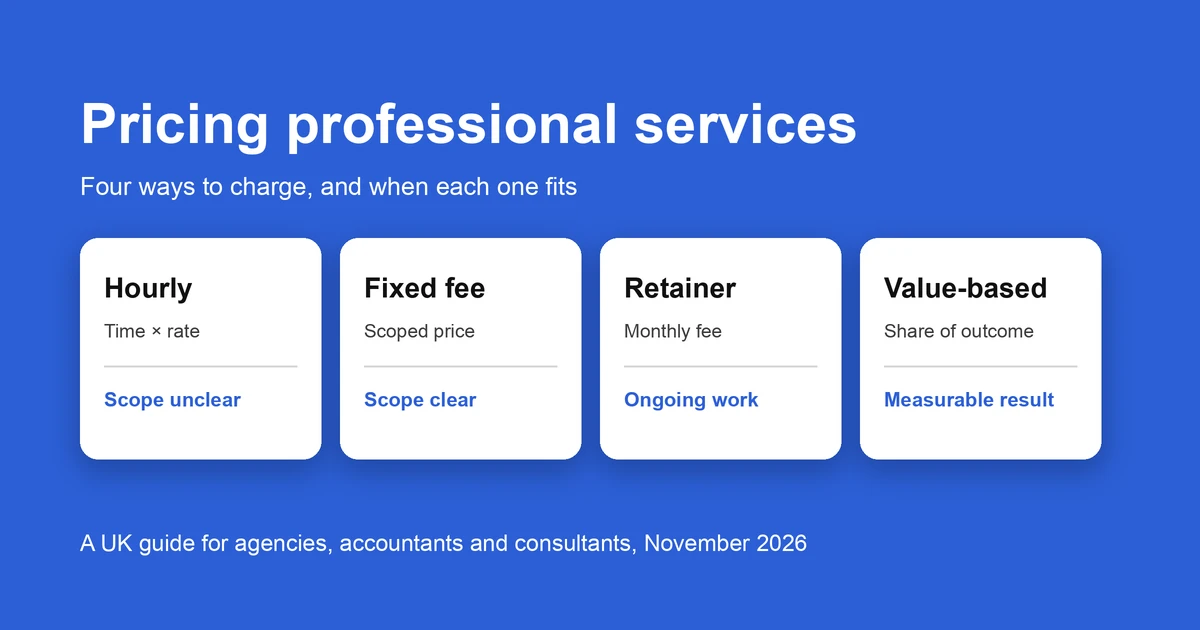
There are four ways to price professional services: by the hour, as a fixed fee, as a monthly retainer, or on the value of the result. Hourly suits work whose scope you can't define. A fixed fee suits work you can scope and have done before. A retainer suits ongoing work with a steady monthly pattern. Value-based pricing suits work with a client outcome you can both measure. Most firms use more than one, matched to the type of work.
Whatever the model, the number starts in the same place: what your time costs, and how much of it the job will take. This guide compares the four models, then works through an example for an agency, an accountant and a consultant. It covers moving from hourly to fixed fees, setting a retainer, and value-based pricing done honestly. We read every source on 7 November 2026. It is general information, not financial or legal advice.
Key Takeaways
- Match the model to the work, not the firm: hourly when the scope is unknown, fixed fee when it's known and repeatable, retainer for steady monthly work, value-based only when the client's outcome can be measured.
- Every model needs a cost floor underneath it: estimated time multiplied by a day or hourly rate that covers your costs and profit.
- To move from hourly to fixed fees, price from your own time records, write down the scope and exclusions, add a contingency sized to the risk, and price changes before you do them.
- AI puts pressure on hourly billing. A Deloitte paper of 13 October 2026 says billable hours "no longer reflect the work's true effort profile or the value delivered" once AI shortens tasks.
- Value-based pricing needs a result with a baseline, a measure and a date agreed in writing. Without those, it's a fixed fee with a story attached.
The four pricing models compared
Each model moves the risk of the work taking longer than expected. With hourly billing the client carries it. With a fixed fee you carry it. A retainer shares it month by month, and value-based pricing ties your fee to whether the result arrives.
| Model | How the price is set | Fits when | Who carries the overrun risk | Main risk to the firm | How to set the number |
|---|---|---|---|---|---|
| Hourly or day rate | Time recorded × rate | Scope can't be defined up front: advice, disputes, discovery, open-ended support | Client | Efficiency lowers revenue; clients dislike open-ended bills | Your rate from costs, target profit and billable days |
| Fixed fee | One price for a defined scope | Scope is clear and you've done similar work before | Firm | Underestimating; scope creep | Estimated time × rate, plus contingency, with exclusions written down |
| Retainer | Fixed monthly fee for agreed capacity, access or deliverables | Ongoing work with a predictable monthly pattern | Shared | Over-servicing; clients resenting unused time | Expected monthly time × rate, reviewed every quarter |
| Value-based | A share of a measurable client outcome, or a price set from it | The outcome is measurable, attributable to your work and large compared with your cost | Firm, often shared through a base fee | Disputes over measurement; outcome outside your control | Value estimate × your share, never below the cost floor |
Deloitte's October 2026 paper on legal pricing draws the same lines. It says time-and-materials pricing "remains appropriate when firms cannot define the scope in advance and do not control the outcome". Deliverable-based pricing "works when firms can define the scope upfront and the work follows a stable, repeatable pattern". Value-based pricing "links fees to realized value". The paper is written for law firms, but the logic carries to any firm that sells expert time (Deloitte, "The pricing paradox for legal services", 13 October 2026).
Start with your cost floor
Before you choose a model, work out the lowest price at which the job still pays. That is the estimated time multiplied by a rate that covers salaries, overheads and profit, divided across the days you can actually bill. Our guide to working out your day rate walks through that sum.
The cost floor matters even when the client never sees it. A fixed fee below it loses money on every job. A value-based fee below it means you're betting your margin on the result. ICAEW's practice guidance puts it plainly: "whether you agree the fee on the basis of time, on a fixed fee basis or on performance", the advice is to "price your work for profit" (ICAEW, fees and charge-out rates, read 7 November 2026).
Two checks keep the floor realistic:
- Use real time records. Price from what similar jobs actually took, not what you hoped they'd take. If you don't record time, start now, even on fixed-fee work.
- Count the hidden time. Calls, emails, reviews, client chasing and rework all go into the estimate. They are the hours most often left out.
Hourly and day rates
Hourly or daily billing charges for time recorded at an agreed rate. It is the right model when nobody can say in advance how much work there is: open-ended advice, investigations, disputes, or a discovery phase before a project is scoped.
Why firms keep it. It's simple, and the client carries the risk of the work growing. It also suits small, irregular pieces of work that aren't worth scoping.
Where it hurts. Clients can't budget for it, so they push back on bills. It also rewards slow work. If a tool halves the time a task takes, an hourly fee halves too. That problem is getting sharper with AI (see How AI changes the pricing question).
How to set the number. Build the rate from your costs and target profit, then check it against the market. For UK management consultants, ITJobsWatch reports a median contract day rate of £554 in the six months to 7 November 2026, from 70 rates quoted in job adverts (ITJobsWatch, read 7 November 2026). That sample is small and IT-heavy, so treat it as a sense check, not a target.
Make it easier to buy. Give an estimate with a range and say what would push it up. Send updates when spend reaches set points, and agree a cap where you can. Label an estimate as an estimate. Our guide to quotes, estimates and ballparks explains what each one commits you to.
Fixed fees, and how to move to them from hourly
A fixed fee is one price for a defined piece of work. Clients like it because they know the cost before they start. It suits work you can describe in advance and have done enough times to estimate well: annual accounts, a brochure website, a standard contract, a defined audit of a process.
The risk moves to you. If the job takes longer, you absorb the difference, unless the extra work falls outside the agreed scope. So a fixed fee is only as good as the scope behind it. ICAEW's fee helpsheet says "If a firm sets a fixed fee, it will be expected to honour it", and that a firm must be clear about the extent of the work the fee covers (ICAEW fee information helpsheet, reviewed 18 August 2025).
Moving from hourly to fixed fees in six steps
- Pick one repeatable service. Start where you have the most history, not with your most unusual work.
- Price from your time records. Take your last 10 or so similar jobs. Look at the typical time and at the spread. A wide spread tells you the scope varies and needs pinning down.
- Write the scope. List the deliverables, the assumptions, what the client must provide and by when, the number of review rounds, and what's excluded. Our scope of work template has a structure you can copy.
- Add a contingency sized to the risk. A repeat job for an existing client needs less than new work for a new client. The figures in the worked examples below (10% and 15%) are illustrative. Use your own records: if similar jobs overran by 20%, a 5% contingency won't cover it.
- Price the likely extras up front. Name the add-ons that often come up and put a price on each. ICAEW's fees and charge-out rates guidance suggests quantifying "the cost of any additional work when you agree the fee". Its example is a £3,000 fee, plus £200 if the firm has to do the bank reconciliation and £150 if it has to write up the fixed asset register.
- Agree a change process. Anything outside the scope gets a written change request, priced before the work starts, usually at your day rate. Put the process in your engagement letter. Our letter of engagement template includes a fees section and a change clause.
After the first batch of fixed-fee jobs, compare actual time with the estimate. Adjust the price, the contingency or the scope wording, then repeat. Keep recording time: it's how you'll know whether a fixed fee is paying.
Handling change requests
Most fixed-fee losses come from small additions that nobody priced. A simple rule stops them: no out-of-scope work starts until the client has agreed a price in writing. If the quote is about to be exceeded for another reason, tell the client before it happens. ICAEW's helpsheet says the firm "should inform the client in advance", give a fresh estimate and seek consent to continue.
Retainers
A retainer is a fixed monthly fee for ongoing work. It suits services that recur every month in a fairly steady pattern: website care, marketing support, monthly bookkeeping, or a standing advice line. The firm gets predictable income. The client gets a known monthly cost and a firm that already knows its business.
Retainers come in three main forms:
- Capacity: a set number of hours or days each month, such as three days of agency time.
- Deliverables: a set package each month, such as monthly bookkeeping, payroll and a management report.
- Access: the right to call on you for advice, with heavy work priced separately.
How to set the number. Estimate the time a typical month takes, multiply by your rate, and decide whether a longer commitment earns a small discount. Then write down the rules that prevent most retainer disputes:
- what's included each month, and what isn't;
- what happens to unused time (for example, it rolls over for one month, then lapses);
- the rate for work beyond the allowance;
- how often you review the fee (every quarter is common), and the notice period.
The main risk is over-servicing. Clients ask for "just one more thing", and the retainer quietly becomes unprofitable. Track the time spent against each retainer every month, even though the fee is fixed. If you're over the allowance for two or three months running, it's time to reprice.
Value-based pricing, done honestly
Value-based pricing sets the fee from what the work is worth to the client, not from the hours it takes. Deloitte describes structuring it "around successful outcomes, risk mitigation, or the value of a client's assets". Done well, it lets a firm earn more from expertise that saves the client a lot of money in a short time.
It only works when four conditions hold:
- The outcome is measurable. Money saved, revenue added or hours removed, with a number attached. "Better brand awareness" doesn't qualify.
- There's a baseline. You and the client agree what the figure is today, from records you can both see.
- Your work causes the change, or most of it. If a price rise or a new hire could explain the result, you'll argue about who gets the credit.
- The value is large compared with your cost. If the result is worth only a little more than your cost floor, a fixed fee is simpler.
When those hold, there are two common structures. One is a fixed fee set from the value, agreed before the work starts. The other is a lower base fee plus a success fee tied to the measured result. Deloitte's M&A example uses that second structure: lower time-based fees for the standardised work, plus a success fee tied to completing the deal.
Where it goes wrong. Some firms call any high fixed fee "value-based" because the client is large. That's not dishonest, but it isn't value pricing either: no outcome is measured and nothing changes if the result doesn't arrive. The other failure is a success fee with a vague measure. Write down the baseline, the measure, the measurement date and who checks the figures, before you start.
Worked examples: an agency, an accountant and a consultant
All three examples use illustrative rates and times. They are not market rates and not anyone's real prices.
Agency: a website on a fixed fee, then a retainer
A small agency is asked to build a 10-page website for a client it hasn't worked with before. Its illustrative day rate is £500. From its time records on similar sites, it estimates the work in phases.
| Phase | Days | Cost at £500 a day |
|---|---|---|
| Discovery and sitemap | 1 | £500 |
| Design | 3 | £1,500 |
| Build | 4 | £2,000 |
| Content loading | 1 | £500 |
| Testing and launch | 1 | £500 |
| Estimate | 10 | £5,000 |
| Contingency, 15% (new client, content not yet written) | £750 | |
| Fixed fee before VAT | £5,750 | |
| VAT at 20% | £1,150 | |
| Total with VAT | £6,900 |
The quote lists the exclusions: copywriting, photography, hosting and third-party subscriptions. It allows two rounds of design changes. After sign-off, the client asks for an online booking page. The agency estimates 1.5 days and sends a change request for £750 plus VAT. Work starts once the client approves it in writing.
After launch, the client wants ongoing updates, SEO work and a monthly report. The agency expects about three days a month, which is £1,500 at its day rate. It offers a six-month retainer at £1,400 a month: £100 less than three days at its day rate, in return for the six-month commitment. Unused time rolls over for one month only, and extra work is charged at £500 a day. For how this fee compares with published UK ranges, see how much a website costs in the UK, or app development costs for larger builds.
Accountant: year-end work as a monthly fixed fee
A small practice prices year-end accounts, the company tax return and one director's self-assessment return for a limited company. Its illustrative charge-out rates are £150 an hour for a partner, £90 for a manager and £60 for a senior. Last year's similar jobs give the time.
| Work | Hours | Rate | Cost |
|---|---|---|---|
| Senior: accounts and returns | 10 | £60 | £600 |
| Manager: review | 3 | £90 | £270 |
| Partner: sign-off and client meeting | 1 | £150 | £150 |
| Estimate | 14 | £1,020 | |
| Contingency, 10% (repeat work, known client) | £102 | ||
| Subtotal | £1,122 | ||
| Fixed fee, rounded up to a whole monthly figure | £1,140 a year, or £95 a month |
The engagement letter says the fee assumes the client's bookkeeping is reconciled. Following ICAEW's approach, the extras are priced up front: £180 if the practice has to reconcile the bank (three senior hours), and £75 a quarter for VAT returns if the client registers. Paying monthly by direct debit spreads the cost for the client and steadies the practice's cash flow. In effect, it's a deliverables retainer. For what UK accountants charge for this work, see accountant fees in the UK.
Consultant: value-based pricing with a measurable result
An independent consultant is asked to cut a distribution firm's delivery costs. The firm spends £800,000 a year with outside carriers. The consultant will review the contracts and run a re-tender. From past work, the consultant expects savings of 5% to 8%, which is £40,000 to £64,000 in the first year.
The cost floor is 12 days at an illustrative £650 a day, or £7,800. Billed by the day, that is the whole fee, whatever the saving. The consultant offers two value-based options instead.
| Option | How it works | Fee if the saving is £30,000 | Fee if the saving is £50,000 | Fee if there's no saving |
|---|---|---|---|---|
| Day rate | 12 days × £650 | £7,800 | £7,800 | £7,800 |
| Fixed fee set from value | £12,000, agreed up front | £12,000 | £12,000 | £12,000 |
| Base plus success fee | £5,000 + 20% of the verified first-year saving, capped at £15,000 | £11,000 | £15,000 | £5,000 |
The fixed fee of £12,000 is 19% to 30% of the expected first-year saving, so the client keeps most of the gain. In the third option, the consultant takes a real risk: with no saving, the fee falls below the £7,800 cost floor.
What makes this fair to both sides is the written measure. The baseline is the last 12 months of carrier invoices. The saving is measured on the 12 months of invoices after the new contracts start, adjusted for changes in delivery volume. The client's finance team supplies the figures, and the success fee is due 30 days after that 12-month period ends.
How AI changes the pricing question
AI tools are shortening tasks that used to take hours: first drafts, research summaries, data extraction, document review. Under hourly billing, that efficiency goes straight to the client as a lower bill.
Deloitte's October 2026 paper sets out the problem for law firms. It draws on Deloitte's 2026 AI Legal Imperative study of 121 senior legal leaders in the UK and Ireland, EMEA, APAC and the Americas. When firms can finish parts of a matter much faster, it says, "billable hours no longer reflect the work's true effort profile or the value delivered". It adds that "Clients see faster turnaround and fewer recorded hours, so they expect lower fees", while firms carry the cost of the tools and training. Deloitte doesn't predict the end of hourly billing. It says "Hourly billing won't disappear but will rather fit in a new highly articulated framework". In its regulatory-filing example, a price per filing package lets the firm keep part of the efficiency gain instead of losing it through fewer billed hours.
The shift is slow so far. Thomson Reuters reports that its Legal Tracker data shows "90% of legal dollars still flow through hourly billing arrangements" (Thomson Reuters, 11 February 2026). That data covers US corporate legal spend, not UK firms.
If AI is cutting your time on a repeatable service, that service is a candidate for a fixed fee, priced on the deliverable. Keep hourly billing for the open-ended work where AI changes less.
Rules for regulated firms
Accountants and solicitors can choose their pricing model, but their rules shape how they explain it.
- ICAEW members. The Code of Ethics, as quoted in ICAEW's fee helpsheet, says a professional accountant "shall explain the basis on which fees will be calculated" (paragraph 330.4). The fee quote or basis must be given in writing, normally in the engagement letter (R330.5). If a fee goes above an earlier quote or estimate, the firm must explain the excess and how it was calculated (R330.4B.2). The helpsheet also says "Fees are a commercial decision". Check the paragraph numbers against the current edition of the Code.
- Solicitors in England and Wales. The SRA Transparency Rules require firms that offer certain services to publish cost information on their website (SRA Transparency Rules, version in effect from 11 April 2025). The services include, for example, residential conveyancing, uncontested probate, some immigration and employment tribunal work, and debt recovery for businesses up to £100,000. The published information must include "the basis for your charges, including any hourly rates or fixed fees" (rule 1.5(b)). Our guide to the SRA price transparency rules shows what to publish, with examples.
If you're regulated, check your body's rules before linking a fee to an outcome. The ICAEW Code restricts contingent fees for audit and other assurance work. For solicitors, fees for litigation that depend on the result fall under the rules for conditional fee and damages-based agreements, and a conditional fee agreement can't be used in criminal or family proceedings (Courts and Legal Services Act 1990, section 58A). Non-contentious work follows different rules. This section is general information, not legal or regulatory advice.
Getting started
Choose one service you sell often. Pull the time records for your last 10 jobs of that type, work out your cost floor, and decide which model fits: hourly if the scope varies a lot, fixed fee if it doesn't, retainer if it recurs monthly. Write the scope and the change process into your engagement letter, then review actual time against the price after a quarter.
Once a service has a set price, you can give enquirers a ballpark before the first call. We make ChatQuote, an assistant for your website that answers enquiries and gives a labelled ballpark from your own rates. It then drafts a quote for you to approve before anything goes out. See how it works for web agencies and for marketing agencies.
Frequently asked questions
What is value-based pricing, compared with cost-based pricing?
Cost-based pricing starts from your costs: time multiplied by a rate, plus a margin. Value-based pricing starts from what the result is worth to the client, such as money saved or revenue added. For a services firm, the cost-based figure is still the floor. A value-based fee only makes sense when it sits above it.
Can you give an example of value-based pricing?
A consultant who expects to save a client £40,000 to £64,000 a year on delivery costs might charge £12,000, rather than 12 days at a day rate. Another option is a £5,000 base fee plus 20% of the verified saving, with a cap. Either way, the baseline and the measure are agreed in writing first.
What is a reasonable consulting fee in the UK?
It depends on the specialism, but ITJobsWatch reports a median management consultant contract rate of £554 a day in the six months to 7 November 2026, from 70 adverts. Use your own cost floor first, then check it against the market.
Is hourly or fixed-price billing better?
Neither is better in general. Hourly suits work you can't scope, and the client carries the risk of overruns. A fixed fee suits work you can scope and have done before, and you carry that risk. Many firms quote fixed fees for defined stages and bill by the hour for open-ended advice.
What should a retainer agreement include?
It should cover what's included each month, what happens to unused time, the rate for extra work, how often the fee is reviewed and the notice period. Track time against the retainer every month so you know when to reprice.
About this guide
Written by the ChatQuote team at CodeLeap Ltd, the company that makes ChatQuote. Sources are Deloitte's October 2026 paper on legal pricing, ICAEW's fee helpsheet and practice guidance, the SRA Transparency Rules, the Courts and Legal Services Act 1990 on legislation.gov.uk, Thomson Reuters' February 2026 market commentary and ITJobsWatch, all read on 7 November 2026. Every rate, time and fee in the worked examples is illustrative, not market data and not ChatQuote or customer data. This is general information, not financial, legal or regulatory advice. Spotted something out of date? Email support@chatquote.app.