
 ChatQuote
SRA transparency rules: what solicitors must publish
Pricing · Published November 11, 2026
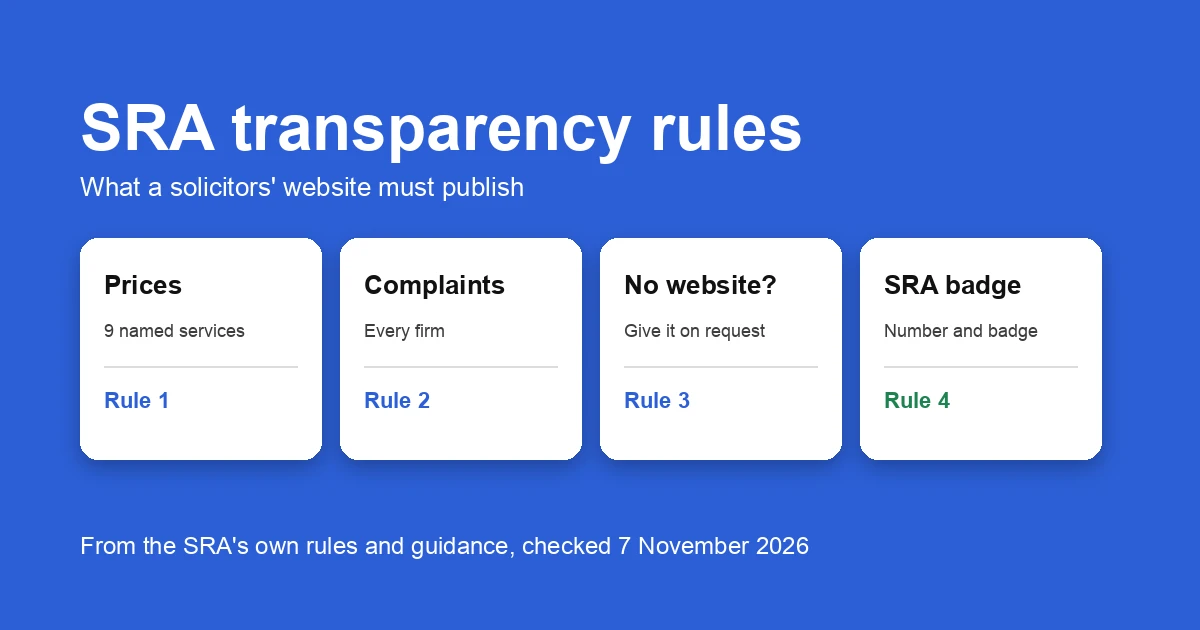
The SRA Transparency Rules make law firms in England and Wales publish four things on their website. If you advertise any of nine named services, such as residential conveyancing or uncontested probate, you must publish price and service information for them (Rule 1). Every SRA-authorised firm must publish its complaints procedure, including how and when to complain to the Legal Ombudsman and the SRA (Rule 2). Firms without a website must give that information on request (Rule 3). Every authorised firm must show its SRA number and the SRA's digital badge (Rule 4).
The price information has seven required parts, from the total cost to who does the work. This guide takes each rule in turn and gives two worked price pages, for a house purchase and for probate. It ends with a checklist you can audit your website against. We read the rules, the SRA's guidance and every other source on 7 November 2026. This is general information, not regulatory or legal advice.
Key Takeaways
- The price rules cover nine services, listed in rules 1.3 and 1.4. They include residential conveyancing, uncontested probate, some immigration work, summary-only motoring offences, unfair dismissal claims, debt recovery up to £100,000 and business premises licensing.
- For each one, rule 1.5 requires the total cost (or an average or range), the basis of charges, disbursements and VAT. It also requires what is and isn't included, key stages and timescales, and who does the work.
- Rule 1.6 says the information must be "clear and accessible and in a prominent place" on your website.
- The SRA's guidance says an online quote generator must give a quote without further contact from the firm. A calculator or chat assistant can sit on top of your price page, but it doesn't replace it.
- The SRA has fined firms £750 for transparency breaches and can issue a further £1,500 penalty for a repeat failure. In its own 2023 evaluation, only 42% of firms said they published all the required price and service information.
Who the rules apply to
The SRA Transparency Rules apply to two groups. The first is any authorised body, meaning a firm the SRA authorises. The second is a solicitor practising in their own right outside a firm under regulation 10.2(b) of the SRA Authorisation of Individuals Regulations, such as a freelance solicitor. The current version has been in effect since 11 April 2025. The SRA Board made it on 16 December 2024.
Each rule has its own trigger:
| Rule | Who it applies to | What it requires |
|---|---|---|
| 1.1 | Firms and freelance solicitors who publish, "as part of its usual business", that they offer a service in rules 1.3 or 1.4 | Price and service information for those services, on the website |
| 1.2 | Exception | Rule 1.1 doesn't apply to publicly funded work |
| 2.1 | All firms and freelance solicitors | The complaints procedure, and how and when to complain to the Legal Ombudsman and the SRA |
| 3.1 | Those without a website | Rule 1 and 2 information on request |
| 4.1 and 4.2 | Authorised firms | SRA number and digital badge on the website; SRA number and the regulated wording on letterhead and emails |
| 4.3 and 4.4 | Solicitors, RELs, RFLs and RSLs serving the public outside an SRA-regulated firm | Tell clients before engagement about insurance and that they can't apply to the SRA Compensation Fund, where applicable |
So the price duty follows what you advertise. If your website says you do residential conveyancing, you publish conveyancing prices. If you don't offer any of the nine services, Rule 1 doesn't apply, but Rules 2 and 4 still do.
The nine services that need published prices
Rules 1.3 and 1.4 list six services for individuals and three for businesses. The SRA's guidance on transparency in price and service (updated 30 September 2024) uses shorter names, shown in the second column.
| Rule | The rule's wording, shortened | The guidance's name and scope notes |
|---|---|---|
| 1.3(a) | Conveyance of residential property: freehold or leasehold sales or purchases, and mortgages or re-mortgages | Residential conveyancing. The SRA doesn't consider transfers of equity to be covered |
| 1.3(b) | Collecting and distributing a deceased person's assets, where these are within the UK and not contested | Probate (uncontested, all assets in the UK). Covers wills and intestacy, taxable and non-taxable estates |
| 1.3(c) | Preparing and submitting immigration applications, excluding asylum | Immigration. Excludes, among others, human rights applications, judicial review and services to businesses such as sponsorship |
| 1.3(d) | Advice and representation at the First-tier Tribunal on appeals against Home Office visa or immigration decisions, excluding asylum appeals | Immigration appeals |
| 1.3(e) | Advice and representation at the magistrates' court on summary-only road traffic offences dealt with at a single hearing | Motoring offences |
| 1.3(f) | Advice and representation for employees bringing unfair or wrongful dismissal claims in the Employment Tribunal | Employment tribunals (claimants) |
| 1.4(a) | Advice and representation for employers defending unfair or wrongful dismissal claims in the Employment Tribunal | Employment tribunals (respondents) |
| 1.4(b) | Debt recovery up to £100,000 | Debt recovery |
| 1.4(c) | Advice, assistance and representation on licensing applications for business premises | New premises licences and variations, under sections 17 and 34 of the Licensing Act 2003 |
Wills, family law and commercial property aren't on the list. Some firms publish prices for them anyway. In the SRA's 2023 evaluation, 21% of firms said they did so for other practice areas.
What the price information must include
Rule 1.5 lists seven items. The right-hand column is what the SRA's guidance adds to each.
| Rule 1.5 | What it requires | What the guidance adds |
|---|---|---|
| (a) | The total cost, or where that isn't practicable, the average cost or range of costs | You can publish the typical cost of a case rather than a mathematical mean. You don't have to publish a binding quote for every scenario |
| (b) | The basis for your charges, including any hourly rates or fixed fees | If you publish a range, give the hourly rates and the factors that set the final price |
| (c) | The experience and qualifications of anyone doing the work, and of their supervisors | Years since qualifying, types of case handled. It can sit on a team page rather than the price page |
| (d) | A description and the cost of likely disbursements, or an average or range where the cost isn't known | Explain "disbursements" in plain English: costs paid to third parties |
| (e) | Whether fees or disbursements attract VAT, and the amount | If you aren't VAT-registered, you must say so on your website |
| (f) | What the price includes, with key stages and likely timescales, and anything a client might reasonably expect to be included but isn't | You don't have to price each stage, only give the total |
| (g) | If you use conditional fee or damages-based agreements, when clients may have to pay you themselves, including from damages | You needn't set out the whole agreement |
Two more points in the guidance often get missed. If you charge differently for online and face-to-face service, you must make that clear. And if you have an online quote generator, it must give the quote "without requiring any additional contact" from your firm.
Rule 1.6 then sets the standard: the information must be "clear and accessible and in a prominent place on your website". The guidance reads that as easy to locate and easy to understand.
How to build a compliant price page, step by step
You can build a page that meets Rule 1 in seven steps. The SRA doesn't prescribe a format, but it publishes format examples for conveyancing, probate and any other service, using a fictional firm called Legal & Co.
Step 1: List every in-scope service you advertise
Go through your website, including any microsites or landing pages for single services. Mark each service that matches rule 1.3 or 1.4. The SRA's year three evaluation (24 October 2023) found firms covering some areas but not others, including where they ran separate websites for different areas of law.
Step 2: Choose how to show the price
Pick fixed fee, range or typical cost for each service. A fixed fee needs a clear list of assumptions. A range needs the hourly rate, the expected hours and what moves a case up or down the range. The SRA's templates show a probate range "between X and X hours" at an hourly rate. Their employment template uses simple, medium and high complexity bands. If you're still setting the fee itself, see how to price professional services.
Step 3: Itemise disbursements and VAT
List each third-party cost, with an amount or a range. Show VAT on your fee and on each disbursement that carries it. For conveyancing quote calculators, the guidance says the total should include every disbursement except Stamp Duty Land Tax or Land Transaction Tax. It also advises against estimating the tax: link to HMRC's Stamp Duty Land Tax calculator or the Welsh Revenue Authority's calculator instead.
Step 4: Say what's included, what isn't, and how long it takes
List the key stages in plain English. Give a typical timescale for the whole matter and, where you can, for each stage. Then name what a client might expect to be included but isn't. The SRA's examples include defective title, a lease extension or extra copies of a grant.
Step 5: Describe the people
Give the experience and qualifications of the people who do the work and of their supervisors. A team page works, as long as the price page links to it. You don't have to say who supervises whom.
Step 6: Put it somewhere prominent, and test it
Link the price page from the service page and from your main navigation or footer. Ask someone outside the firm to find the probate price from your home page. Whatever they click on the way is your route to the price.
Step 7: Check the rest of the page furniture
Your complaints information (Rule 2) and the SRA number and badge (Rule 4) apply to every firm, whether or not Rule 1 does. They are covered in the complaints and badge section below.
Worked example: a residential purchase
Illustrative only. This is a fictional firm, and its legal fee, transfer fee, search estimate and timescales are made up. The HM Land Registry fee and VAT rate are real, from GOV.UK. The layout follows the SRA's freehold purchase template.
Buying a freehold house in England for £300,000, with a mortgage
Our fee covers all the work needed to buy your home, including registering you as owner at HM Land Registry and paying the Stamp Duty Land Tax for you.
| Item | Amount |
|---|---|
| Legal fee | £1,000.00 |
| VAT on legal fee (20%) | £200.00 |
| Electronic money transfer fee | £40.00 |
| VAT on transfer fee (20%) | £8.00 |
| Our fees, including VAT | £1,248.00 |
| Search fees (estimate; these vary by council and property) | £300.00 |
| HM Land Registry fee | £150.00 |
| Estimated total, excluding Stamp Duty Land Tax | £1,698.00 |
- The HM Land Registry fee is the Scale 1 fee for a transfer of a whole registered title worth £200,001 to £500,000, applied for through the portal (GOV.UK, page last updated 28 April 2025, read 7 November 2026). The postal fee for the same band is £330.
- Stamp Duty Land Tax depends on the price and your circumstances. Use HMRC's calculator. It is paid on top of the total above.
- What the fee assumes: a registered freehold, a standard transaction with no defect in title, a co-operative chain and no indemnity policies.
- What isn't included: leasehold work, a new build, shared ownership, Help to Buy or unregistered land, each of which we price separately.
- Key stages: taking your instructions; receiving and checking the contract; searches and enquiries; reporting to you and your lender; exchange; completion; paying Stamp Duty; registration.
- Timescale: usually 8 to 12 weeks from your offer being accepted to completion, longer in a long chain.
- Who does the work: a named conveyancer with their years of experience, supervised by a named partner, linked to the team page.
The VAT rate is the standard rate on GOV.UK (read 7 November 2026). For a closer look at what goes into a conveyancing quote, see our guide to conveyancing quotes and the SRA's conveyancing format example.
Worked example: uncontested probate
Illustrative only. The hours, hourly rate and timescales belong to a fictional firm. The probate application fee and the Gazette notice price are real and dated. The layout follows the SRA's "range of costs" probate template.
Applying for the grant, collecting and distributing the assets
We expect this to take 10 to 15 hours of work at £250 an hour plus VAT at 20%.
| Item | Low | High |
|---|---|---|
| Legal fees (10 to 15 hours at £250) | £2,500.00 | £3,750.00 |
| VAT on legal fees (20%) | £500.00 | £750.00 |
| Legal fees, including VAT | £3,000.00 | £4,500.00 |
| Probate application fee (estate over £5,000; no VAT) | £526.00 | £526.00 |
| Three extra copies of the grant, ordered with the application (£2 each) | £6.00 | £6.00 |
| Deceased estates notice in The Gazette (£96.55 plus VAT) | £115.86 | £115.86 |
| Estimated total | £3,647.86 | £5,147.86 |
- Sources for the third-party fees: the probate application fee and copy fees from GOV.UK, and the deceased estates notice price from The Gazette, both read 7 November 2026.
- Also likely: bankruptcy-only searches against each beneficiary, charged per name by HM Land Registry, and a notice in a local newspaper. Give your current figure for each.
- The range assumes: a valid will; one property at most; no more than four bank or building society accounts; two to four beneficiaries; no inheritance tax to pay and no full account to HMRC; no disputes and no claims against the estate.
- What moves the cost: one beneficiary and no property sits at the lower end. Several accounts, a property and more beneficiaries push it higher.
- What isn't included: selling or transferring the property, share portfolios, and inheritance tax returns. We quote for these separately.
- Other in-scope estates: intestacies and taxable estates are covered by rule 1.3(b) too, so the fictional firm publishes a separate price for each.
- Key stages and timescale: getting the grant, usually 8 to 16 weeks; collecting the assets, 6 to 12 weeks; distributing the estate, 4 to 8 weeks. Most estates in this range finish within 6 to 12 months.
- Who does the work: a named solicitor with their years of experience in probate, supervised by the head of department.
Following the SRA's guidance, the page doesn't estimate the inheritance tax. It links to HMRC instead.
Complaints information and the SRA badge
Complaints (Rule 2). Every firm must publish its complaints procedure and how and when a complaint can go to the Legal Ombudsman and the SRA. The SRA's guidance on publishing your complaints procedure (updated 23 March 2023) gives suggested wording. It says a complaint must reach the Ombudsman within six months of your final response. It must also be no more than a year from the problem, or from when the client should reasonably have known about it.
The SRA number and badge (Rule 4.1). Display both "in a prominent place" on your website. The SRA's clickable logo page says the badge became mandatory on 25 November 2019. It only works on web addresses recorded in your mySRA account, and the SRA says to allow 24 hours after updating them. The year three evaluation found some firms displaying it so that the dynamic link didn't work.
Letterhead and email (Rule 4.2). Show your SRA authorisation number and the words "authorised and regulated by the Solicitors Regulation Authority".
Price calculators and chat assistants
The rules don't mention calculators or chat assistants, but the SRA's guidance covers online quote generators. Three rules of thumb follow from it and from the Code of Conduct:
- Publish the price page first. A calculator or a chat assistant adds to Rule 1 information on your website. It isn't a substitute for it, because the rule requires the information to be published.
- Don't hold the price back for contact details. The guidance says a quote generator must give a quote without the firm having to call first. It also notes that people dislike being made to hand over an email address or phone number to see a price. Make the figure available before you ask for details, and handle any data you do collect under data protection law, as the guidance reminds you.
- Keep every figure consistent with your published prices, and label it. Paragraph 8.8 of the Code of Conduct for Solicitors says your publicity must be "accurate and not misleading", including about your charges. Paragraph 8.7 asks for the best possible information about how a matter will be priced.
Consumer law
Consumer law points the same way. Since 6 April 2025, the Digital Markets, Competition and Consumers Act 2024 has treated misleading presentation of true information as a misleading action (section 226). It also counts unclear or untimely information as an omission (section 227). An invitation to purchase must give the total price, or how it will be calculated (section 230).
What a chat reply should say
Take a chat question like "how much to buy a £300,000 house?". The reply should give the same figure and assumptions as the page, say it is an estimate, and link to the full breakdown. It should hand anything outside the published assumptions, such as a leasehold with a short lease, to a person. Our guide to quotes, estimates and ballparks explains why that label matters.
We make ChatQuote, an AI assistant for a firm's website. It answers enquiries from your own briefing and documents and gives a labelled ballpark from your own rates. It then drafts a quote that waits for your approval before it is sent. It doesn't replace the price page Rule 1 requires, and it isn't a compliance tool. See a website chatbot that gives a price.
For where else AI fits in a small firm, and the confidentiality limits, see AI for law firms.
Enforcement and what has changed since 2023
Compliance is patchy. In the SRA's year three evaluation (24 October 2023), 74% of firms offering the nine services said they published some of the required price and service information. Only 42% said they published all of it. The SRA's spot checks of firms that had declared compliance found as many as two-thirds weren't fully compliant.
Fixed penalties. In a January 2024 release, the SRA reported £750 fines for seven firms that didn't comply with the transparency rules, after three in November 2023. Firms that keep failing could face a further fixed penalty of £1,500. Firms receive a notice first, with a chance to put things right. The same release says the SRA's maximum direct fine for traditional firms rose from £2,000 to £25,000.
The current version of the rules has been in effect since 11 April 2025, and the SRA last updated its price and service guidance on 30 September 2024. We found no new price requirements in either: the nine services and seven items above are the same ones the guidance describes.
Paused further changes
Further changes are paused. The SRA's draft business plan for November 2026 to October 2027 says it will "pause further work building on the evaluation of our transparency rules". Work on quality indicators and digital comparison tools is paused too, so the SRA can focus on client money. The Legal Services Consumer Panel's chair called the pause misguided, as the Law Gazette reported on 30 June 2026. In a 16 July 2026 statement, the SRA said it would revise the plan after consultation. When we checked on 7 November 2026, the SRA's business plans page didn't yet list the final plan, and we found no year five evaluation of the rules.
Background. The rules respond to the Competition and Markets Authority's legal services market study, whose final report (15 December 2016) found competition for individuals and small businesses wasn't working well. The Legal Services Board's statement of policy on empowering consumers (11 April 2022) expects regulators to ensure useful information about "the price, or potential price" of services.
Checklist: audit your website
Work through this for each in-scope service you advertise.
- Every service from rules 1.3 and 1.4 that you advertise has a price page, including on any separate websites.
- Each page gives a total cost, or an average or range, with the basis of charges (hourly rate or fixed fee).
- Ranges come with the factors that move a case up or down.
- Each likely disbursement is named, with an amount or a range.
- VAT is shown on fees and on each disbursement that carries it, or the page says you aren't VAT-registered.
- The page says what is included, what a client might expect but isn't, the key stages and the likely timescales.
- Any difference in price between online and face-to-face service is explained.
- If you use conditional fee or damages-based agreements, the page says when clients pay themselves.
- The experience and qualifications of the people who do the work, and their supervisors, are on the page or one click away.
- The price page is linked from the service page and can be reached from the home page.
- Any quote calculator gives a figure without the firm having to call, and a chat assistant gives figures consistent with the page, labelled as estimates.
- The complaints procedure and the Legal Ombudsman and SRA routes are published.
- The SRA number and a working digital badge are prominent, on every web address in mySRA.
- Letterhead and emails carry the SRA number and the "authorised and regulated" wording.
- Someone owns the page and rechecks the figures whenever fees, HM Land Registry fees or court fees change.
Once a client instructs you, your client care letter takes over. See our letter of engagement template for what goes in it.
Frequently asked questions
Do the SRA transparency rules apply to wills?
No. Will writing isn't one of the nine services, so Rule 1 doesn't require you to publish will prices. Rule 1.3(b) covers uncontested estate administration, where all the assets are in the UK. Rules 2 and 4 still apply to every firm.
Do we have to publish a fixed fee?
No. Rule 1.5(a) asks for the total cost or, where that isn't practicable, an average cost or a range. The SRA's guidance says a typical cost is acceptable, and that you don't have to publish a binding quote for every scenario. With a range, you must give the basis of charges, such as hourly rates, and the factors that decide the final price.
Can we ask for an email address before showing a price?
The SRA's guidance says an online quote generator must produce a quote without further contact from your firm. It also says people dislike being made to give contact details to see a price. The published price page must be open to everyone in any case.
What happens if we don't comply?
The SRA writes to the firm first. If the firm doesn't put it right, the SRA can issue a fixed penalty: it has issued £750 fines for transparency breaches, and £1,500 can follow for a repeat. More serious cases can lead to a larger fine or other action.
Your next step
Run the checklist against your website this week, starting with the service you advertise most. Fix the gaps the SRA's spot checks found most often: missing service areas, missing complaints information, and a badge that doesn't link. Then make sure every price you quote elsewhere, in chat or on the phone, matches the page.
If you'd like your website to answer price questions from your own rates and draft quotes for you to approve, ChatQuote has a 30-day free trial, and no card is needed.
About this article
Written by the ChatQuote team at CodeLeap Ltd, the company that makes ChatQuote. The rules are quoted from the SRA Transparency Rules (version in effect from 11 April 2025) and the SRA Code of Conduct for Solicitors. Guidance, examples, evaluation findings and plans come from the SRA's own website. Fees come from GOV.UK and The Gazette, and the law from legislation.gov.uk. All sources were read on 7 November 2026. The two worked examples are illustrative: the firm, its fees, hours and timescales are invented, and only the third-party fees named are real.
This is general information for firms in England and Wales, not regulatory or legal advice. For a ruling on your own position, contact the SRA's Professional Ethics helpline. Spotted something out of date? Email support@chatquote.app.