
 ChatQuote
How much does an app cost to build in the UK in 2026?
Pricing · Published November 11, 2026
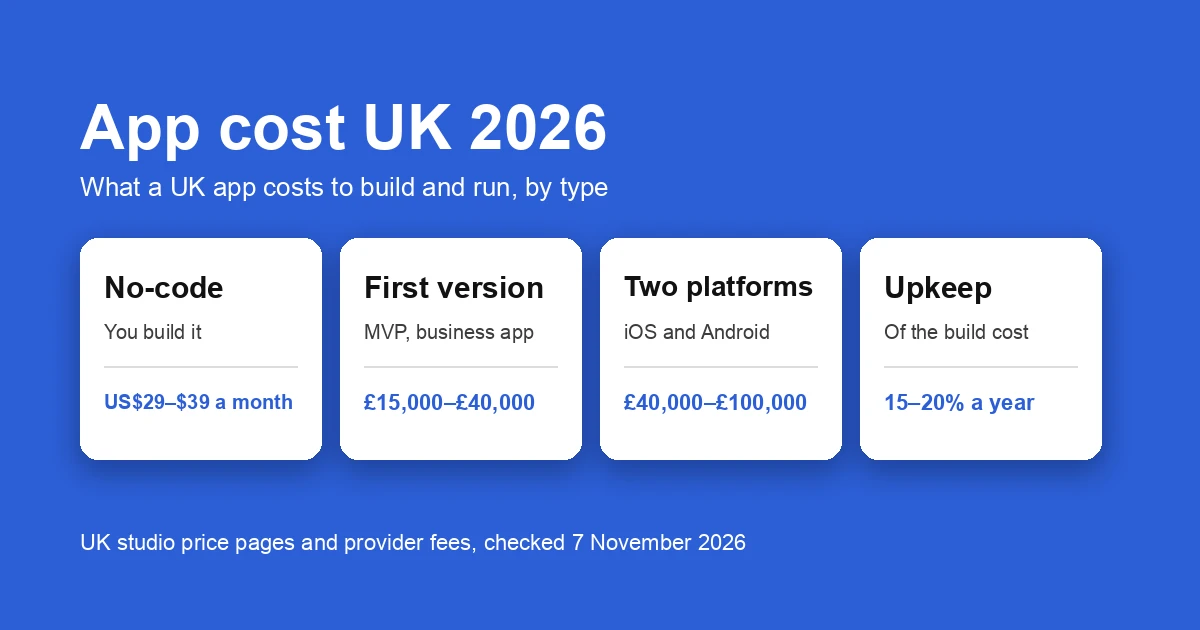
A bespoke app built by a UK studio costs from about £15,000 for a first version to £100,000 for an app on both iPhone and Android, and more for a complex build. Those are the bands two UK studios publish for their own work, checked on 7 November 2026. Building it yourself on a no-code tool costs from US$29 a month (billed yearly) or US$39 billed monthly. A third studio, which builds consumer apps for funded companies, puts the average UK consumer app at £150,000.
The sources measure different things, so the table names each one rather than averaging them. After the build prices come the running costs: store fees, commission, hosting and maintenance. Studios and agencies benchmarking their own prices will find a worked estimate built from a day rate.
Key Takeaways
- Two UK studios publish £15,000 to £40,000 for a first version (MVP) of a business app, read 7 November 2026. A third, pricing consumer apps for funded companies, puts an MVP at £60,000 to £250,000.
- An app for both iPhone and Android costs £40,000 to £100,000 in Tappable's published ranges, which exclude VAT.
- Store fees are small: Apple charges US$99 a year and Google Play US$25 once. For an app that sells digital goods, commission costs more: 15% to 30% on Apple, and 15% to 30% on Google Play in the UK.
- Budget 15 to 20% of the build cost a year for maintenance, Tappable says. That is £6,000 to £8,000 a year on a £40,000 app.
- A studio prices an app as estimated days × a day rate, plus contingency. The worked example below comes to £38,582.50 before VAT.
What an app costs in 2026, by type
The cheapest route is a no-code builder you use yourself. The dearest is a complex app with its own back end, built natively for each platform. The table shows each type with the range each named source gives, side by side where they differ.
| App type | Range | Source and date |
|---|---|---|
| Build it yourself on a no-code tool | US$351 billed yearly (shown as US$29 a month) or US$39 a month billed monthly, FlutterFlow Basic, the cheapest plan that publishes to the app stores | FlutterFlow pricing, read 7 November 2026 |
| Proof of concept or prototype | £5,000 to £25,000 | Pocketworks, updated 9 July 2026 |
| First version (MVP) of a business app | £15,000 to £40,000 | Tappable, read 7 November 2026; Foresight Mobile, updated 6 October 2026 |
| First version (MVP) of a consumer app, funded company | £60,000 to £250,000 | Pocketworks, updated 9 July 2026 |
| Mobile app, one platform | £25,000 to £60,000 | Tappable |
| Medium-complexity app, one codebase for iPhone and Android | £40,000 to £80,000 | Foresight Mobile |
| Mobile app, iOS and Android | £40,000 to £100,000 | Tappable |
| Web portal or platform | £20,000 to £60,000 | Tappable |
| Business system or internal platform | £15,000 to £60,000 | Tappable |
| Complex or enterprise app | £80,000 or more | Foresight Mobile |
All three studios publish the bands they quote for their own projects, so treat them as price lists, not market surveys:
- Tappable says its figures exclude VAT and are "the ranges we quote, not an industry average". It doesn't take projects under £10,000. The page carries no date, so we give the date we read it.
- Foresight Mobile's bands are for one app that runs on both iPhone and Android from a single codebase. It says separate native apps cost more. The page doesn't say whether prices include VAT.
- Pocketworks bases its figures on ten years in the industry and talks with other agencies. It assumes a UK-funded startup, scaleup or established organisation using a mid-sized UK agency. It says the average consumer app in the UK has dropped from £300,000 to £150,000 in 2026, as AI speeds up development. It doesn't say when the £300,000 figure applied. A later section of the same article gives £4,000 to £30,000 for a proof of concept and £80,000 to £250,000 for an MVP. VAT isn't stated.
Pocketworks' MVP band starts at £60,000, £20,000 above the top of the other two studios' £15,000 to £40,000 bands. Our reading, not the sources': Pocketworks prices a consumer product with user research and growth work built in. Tappable and Foresight Mobile price a business app with a defined job.
For a global cross-check, the directory Clutch puts the average app project at US$90,780.11. It says most projects on its site cost US$10,000 to US$49,999 (Clutch, updated 21 September 2026). Clutch draws on client reviews from many countries and gives no UK figure, so it suits a sense of scale, not a UK budget.
What drives the price
Much of an app's cost is people's time: design, build, testing and project management. Anything that adds days adds cost, even when the final price is a fixed fee.
- Features and screens. Foresight Mobile's simple band is "a handful of screens, standard UI, one clear job". Its medium band adds user accounts, payments, third-party integrations and a proper back end.
- Integrations and hardware. Tappable says integrations with existing systems, hardware, offline working, regulated-sector requirements and the number of user types move the price more than the number of screens.
- One codebase or two. A cross-platform tool such as Flutter or React Native ships one codebase to both stores. Native apps mean building for iOS and Android separately, which Foresight Mobile says costs more.
- The back end. Accounts, data and an admin panel need a server side. A managed service such as Firebase or Supabase saves build time (prices below).
- Design. A standard component library is quicker than a custom design with its own animations.
- Accessibility. GOV.UK says public sector apps built for the public must meet WCAG 2.2 at level AA. Private businesses aren't covered by those regulations, but it's a clear standard to ask for, and testing against it takes time.
- Who builds it. A contractor sells days; a studio sells a team (see day rates below).
- VAT. A business must register for VAT once its taxable turnover passes £90,000 in 12 months (GOV.UK). It then adds 20% VAT. If your business can't reclaim VAT, compare prices including it.
What an app costs to run
An app's running costs start at about US$99 a year for the Apple developer account, plus commission on in-app sales of digital goods, hosting and maintenance. Maintenance is usually the biggest line.
| Running cost | Example price | Source, read 7 November 2026 |
|---|---|---|
| Apple Developer Program | US$99 a year, charged in local currency where available | Apple Developer Program |
| Google Play developer account | US$25, one-time registration fee | Play Console Help |
| Back end, starter tier | Firebase Spark plan: no cost, 50,000 monthly active users for sign-in; Supabase Free: US$0, 50,000 monthly active users, 500 MB database | Firebase pricing, Supabase pricing |
| Back end, paid tier | Firebase Blaze: pay as you go above the free quotas; Supabase Pro: from US$25 a month, 100,000 monthly active users | As above |
| Maintenance | 15 to 20% of the build cost a year (Tappable); £675 to £1,495 a month on Foresight Mobile's care plans, so from £8,100 a year | Tappable; Foresight Mobile, updated 6 October 2026 |
Supabase pauses free projects after one week of inactivity, so a live app needs a paid plan. Tappable says hosting for most business systems costs "tens of pounds a month rather than hundreds". Foresight Mobile says managed services keep hosting near zero at low user numbers.
App store commission
Apple and Google take a cut when your app sells digital goods or services, such as subscriptions or in-app purchases.
Apple takes 30% on digital goods and services sold through the App Store (Apple Developer Program, read 11 November 2026). Two lower rates apply:
- Small developers: 15% in the App Store Small Business Program, for developers with up to US$1 million in proceeds in the previous calendar year, and for new developers. Members pay 15% on subscriptions from the start.
- Subscriptions after a year: for other developers, an auto-renewing subscription pays 30% in the subscriber's first year of paid service and 15% after that (Apple subscriptions).
Apple says different rates may apply in Brazil, the EU, Japan, the Netherlands, Russia and South Korea. The UK isn't on that list.
Google Play changed its fees for UK users on 30 June 2026 (Google's service fees page, read 11 November 2026). The fee depends on the purchase type and on whether the user installed the app before or after that date. Most fees are a service fee plus a 5% billing fee, which applies when the user pays through Google Play's billing, or buys a paid app.
| Google Play fee, UK users | Subscriptions | Other purchases, installed on or after 30 June 2026 | Other purchases, installed before 30 June 2026 |
|---|---|---|---|
| First US$1 million of annual earnings | 10% + 5% (15%) | 10% + 5% (15%) | 10% + 5% (15%) |
| Standard rate | 10% + 5% (15%) | 20% + 5% (25%) | 25% + 5% (30%), or 20% in total for purchases through an external web link, with no billing fee listed |
Google's Apps Experience and Play Games Level Up programmes lower the standard rate for other purchases by five points. The page doesn't say in words when the standard rate replaces the first-US$1-million rate, or whether you must enrol to get it; read it alongside your developer agreement before you model revenue.
Commission matters for a paid or subscription app; a free booking or customer-service app may never pay it. Ask a studio to model it if your app charges inside the app.
How to compare app quotes
Two app quotes can differ by tens of thousands of pounds, often because they describe different projects. Put them side by side on these points before you compare the totals.
- Platforms. iPhone, Android, web, or all three? One codebase or two?
- Features. Is each feature named as a line, with what's out of scope listed too?
- Back end and admin. Who hosts it, on whose account, and what does it cost a month?
- Discovery. Is there a paid scoping phase first, and is its fee credited against the build?
- Fixed fee or time and materials. What happens when you ask for a change?
- Testing. Which devices, and is it checked against WCAG 2.2 AA?
- Ownership. Will the source code, the store accounts and the domain be in your name?
- After launch. What does maintenance cost from month two, and what does it cover?
- VAT and payment stages. Is the price with or without VAT, and how much is due before work starts?
A written scope makes these comparisons possible; our scope of work template shows what one covers. A rough figure on a call is a ballpark, not a quote. Our guide to quotes, estimates and ballparks explains what each commits a supplier to.
How a studio scopes an app estimate
A studio prices an app in four steps: scope it, estimate the days each feature takes, multiply by a day rate and add contingency. It then sells the result as a fixed fee or as time and materials. Studios and agencies reading to benchmark can work through the steps below. For pricing models beyond day rates, see how to price professional services.
1. Discovery
Discovery turns an idea into a list of features, screens and integrations that can be estimated. Many studios charge for it. Foresight Mobile, for example, sells a four-week "App Gameplan" for £3,500 and credits it against the first development sprint. A paid discovery gives the client a costed plan and gives the studio a scope it can price.
2. Day rate × days
Your day rate comes from your costs, the pay you need and the days you can bill. Our guide to working out your day rate has the method and a calculator. For a market check, ITJobsWatch gives these median UK contract day rates for the six months to 7 November 2026:
| Role or skill | Median day rate | Daily rates quoted | Source |
|---|---|---|---|
| Mobile developer | £375 | 15 | ITJobsWatch |
| iOS developer | £401 | 47 | ITJobsWatch |
| Android developer | £450 | 47 | ITJobsWatch |
| React Native (skill) | £500 | 53 | ITJobsWatch |
These are advertised contractor rates, and the samples are small: 15 rates for "mobile developer". A studio's rate covers design, testing and project management too. Pocketworks puts freelancers and contractors at £400 to £600 a day and agencies like itself at £650 to £1,200.
3. Effort by feature, plus contingency
The worked example below is illustrative: the day rate and the days are made up for the example, not market data. It prices a first version of a booking app for a small business. It has one cross-platform codebase, customer accounts, bookings, card payments, push notifications and a simple web admin panel. The studio charges £550 a day.
| Phase or feature | Days | At £550 a day |
|---|---|---|
| Discovery and scoping | 3 | £1,650 |
| UX and UI design: 12 screens, two rounds of changes | 8 | £4,400 |
| App build: accounts, bookings, notifications | 20 | £11,000 |
| Back end and web admin panel | 12 | £6,600 |
| Card payments through a payment provider | 4 | £2,200 |
| Testing on devices, accessibility checks | 6 | £3,300 |
| App store submission and launch | 2 | £1,100 |
| Project management | 6 | £3,300 |
| Subtotal | 61 | £33,550 |
| Contingency, 15% | £5,032.50 | |
| Price before VAT | £38,582.50 | |
| VAT at 20% | £7,716.50 | |
| Price including VAT | £46,299 |
The £38,582.50 price sits at the top of Tappable's and Foresight Mobile's £15,000 to £40,000 MVP band. Scope moves it. Move payments and half the admin panel (10 days) to a second phase, and the first version is 51 days: £28,050, or £32,257.50 with contingency. The quote should also list what's excluded, such as store fees, hosting, the payment provider's charges and maintenance.
Contingency covers the unknowns an estimate can't see yet, such as an awkward integration or app store review feedback. The less settled the scope, the larger it should be.
4. Fixed fee or time and materials
A fixed fee sells the scope at a set price. The client knows the cost, and the studio carries the risk of overruns, which is why contingency sits inside it. Changes outside the scope need a priced change request.
Time and materials bills the days actually worked at the day rate, often sprint by sprint. The client carries the risk, but can change direction without renegotiating. It suits work after launch and projects whose scope can't be pinned down yet.
Many studios combine the two: a fixed fee for discovery and the first version, then time and materials or a monthly care plan after launch.
Putting a ballpark on your own site
When a prospect asks "roughly how much is an app?", a studio can answer with a range. It works the range out from its day rate and a few scoping questions (platforms, features, integrations, deadline), then sends an itemised quote after a call.
We make ChatQuote, an assistant for your website that asks those scoping questions. If you switch it on, it gives a non-binding ballpark from your own rates. It then drafts a quote for your team to review before it goes out. See how it works for web agencies.
Frequently asked questions
How much does it cost to put an app on the App Store?
The Apple Developer Program costs US$99 a year, in local currency where available, and Google Play charges a one-time US$25. If the app sells digital goods or subscriptions, Apple also takes 15% or 30% commission. The cost of building the app comes on top: £15,000 to £40,000 for a first version in two UK studios' published bands.
How much does it cost to run an app per month?
For a small app, hosting on a starter tier can cost nothing: Firebase's Spark plan and Supabase's Free plan are both free. Supabase Pro starts at US$25 a month. Maintenance is the larger cost: Tappable says 15 to 20% of the build cost a year, and Foresight Mobile's care plans run from £675 a month.
Does Google take 30% of in-app purchases?
For some purchases, yes. For UK users, Google's fees as read on 11 November 2026 are:
- On the first US$1 million of annual earnings: 15% on everything (10% plus a 5% billing fee).
- At the standard rate: 15% on subscriptions, 25% (20% + 5%) on other purchases by users who installed on or after 30 June 2026, and 30% (25% + 5%) on other purchases by users who installed before then.
Google's page doesn't say when the standard rate replaces the first-US$1-million rate, so check your developer agreement.
The 5% billing fee applies when the user pays through Google Play's billing, or buys a paid app.
Can AI build an app for me?
It can build a prototype. Foresight Mobile says AI app builders can stand up an MVP prototype for under £500, which suits validating an idea. It adds that security, scale, store review and maintenance still need proper engineering before paying customers use the app.
Do app developers charge VAT?
Only if they are VAT-registered, which is compulsory once taxable turnover passes £90,000 in 12 months. A registered developer adds 20%. Tappable's published ranges exclude VAT; Foresight Mobile's and Pocketworks' don't say.
About this article
Written by the ChatQuote team at CodeLeap Ltd, the company that makes ChatQuote. Prices come from three UK studios' published price pages, Clutch's pricing guide, ITJobsWatch and the providers' own pricing pages, all read on 7 November 2026; Apple's and Google's commission pages were re-read on 11 November 2026. They are not ChatQuote or CodeLeap data. The worked estimate uses illustrative figures. App store fees and commission rules change, so check them before you budget. This article is general information, not tax or financial advice. Spotted something out of date? Email support@chatquote.app.
Related: how much a website costs in the UK.