
 ChatQuote
AI for accountants: what UK practices can safely use in 2026
AI and automation · Published November 2, 2026
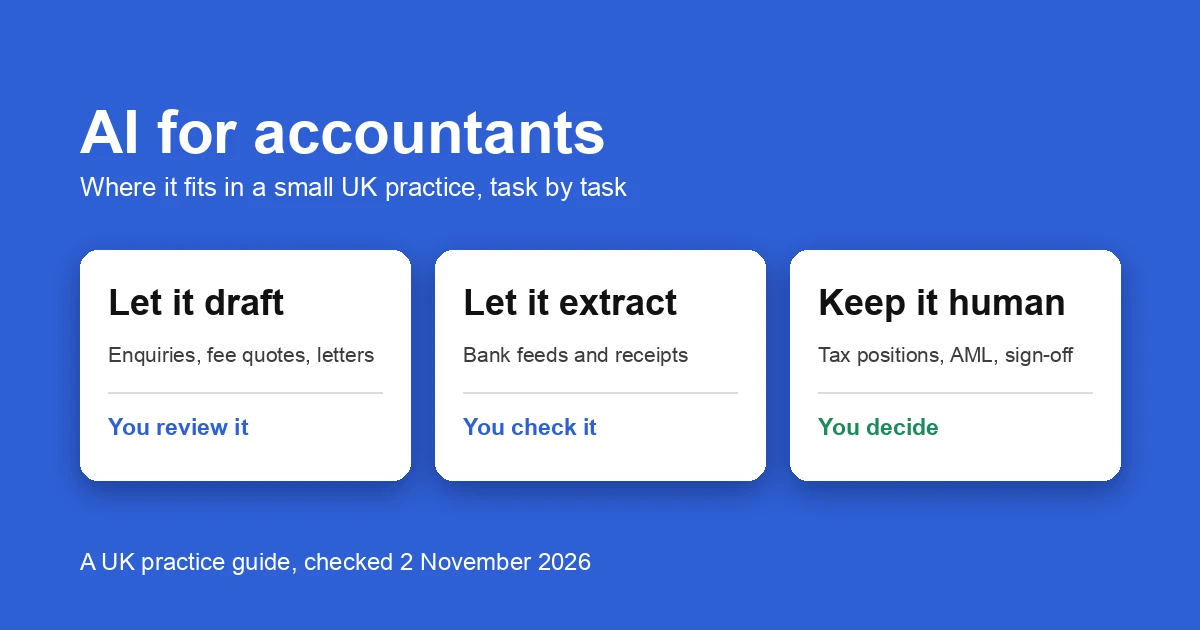
AI can take real work off a small accounting practice in 2026. It can answer website enquiries, give a labelled ballpark from your own fee schedule and draft a quote for you to approve. It can also draft engagement letters and emails, categorise bank transactions and pull figures out of receipts and statements. What it can't take is responsibility for any of it. Tax positions, the money-laundering risk assessment and anything you sign stay with a qualified person. Client data stays out of public AI tools.
That is where the professional bodies land too. ICAEW's Code of Ethics now says professional competence and confidentiality cover technology. The Consultative Committee of Accountancy Bodies (CCAB) has published a draft statement on AI. It says accountants "cannot abdicate responsibility for outputs" of the AI tools they use. This guide takes each task in turn: what AI can do, what still needs you, and the risk. We checked every source on 2 November 2026. It is general information, not professional or legal advice.
Key Takeaways
- AI is most useful where the output is a draft or a match that a person checks: enquiry replies, fee ballparks, letters, categorisation and document extraction.
- Tax positions, the money-laundering risk assessment and sign-off, and anything you sign or file stay with a qualified person.
- Don't put client information into public AI tools. ICAEW says doing so is "very likely" to breach client confidentiality.
- Where an AI tool processes personal data, the ICO expects a data protection impact assessment in "the vast majority of cases". Your firm is usually the controller, and the tool's provider a processor.
- Before switching a tool on, ask where the data goes, whether it trains on your inputs, what audit trail it keeps and who reviews its output.
AI in a small practice at a glance
Across six areas of a small practice's work, the pattern is the same: AI produces the first draft or the first match, and a qualified person decides.
| Task | What AI can do | What stays with a qualified person | Main risk |
|---|---|---|---|
| Website enquiries and fee quotes | Answers questions, asks scoping questions, gives a labelled ballpark from your fee schedule, drafts a quote | Accepting the client, the final fee, any tax advice | A figure read as an offer; enquirers' personal data |
| Engagement letters and onboarding | Can draft the letter and welcome emails from your templates | Scope, limitations, client due diligence | A letter that doesn't match the work |
| Bookkeeping and bank feeds | Suggests categories and matches bank lines | VAT treatment, capital or revenue, unusual items | Accepting suggestions unchecked |
| Document collection and extraction | Reads receipts, invoices and statements and extracts the figures | Checking totals against the source | Wrong figures carried into returns |
| Tax research and drafting | Summarises, drafts emails and first-draft explanations | Every tax position and its source | Invented or out-of-date law |
| Review and analytics | Can flag unusual items and draft variance commentary | The conclusion and what you tell the client | Over-reliance on an opaque tool |
What the professional bodies and the ICO say
The rules don't ban AI. They make you answerable for it, and they set limits on client data.
ICAEW
A new edition of the ICAEW Code of Ethics came into force on 1 July 2026, carrying the technology revisions ICAEW made to the Code in 2025. ICAEW's summary of them cites these paragraphs (references are written as that page writes them):
- Competence. Keep a "continuing awareness and understanding" of technology-related developments. Where limits on your work include limits of technology, explain their implications to the client (113.1 A3, R113.3).
- Confidentiality. Protect client information through its whole life cycle, from collection and storage to lawful destruction (R114.1.A1).
- Using a tool's output. Before relying on it in professional work, decide whether it is appropriate for the purpose. The factors include the nature of the activity and how far you will rely on it (R320.11, 320.11.A1).
ICAEW is direct about public tools. A February 2024 regulatory news item says putting client data into tools such as ChatGPT gives "limited visibility and control" over where it goes. Where client data is involved, it is "very likely" to breach client confidentiality. ICAEW's generative AI guide adds that these tools "do not make up for a lack of professional knowledge and skill".
CCAB and ACCA's technical site
The Consultative Committee of Accountancy Bodies published a draft statement on the ethical use of AI in June 2026. The statement says AI doesn't diminish your personal responsibility. It also asks accountants to be transparent with clients about the use of AI tools, state this clearly in the engagement letter, and "document judgements and safeguards".
An article by the law firm Kingsley Napley on ACCA's technical site (March 2026) covers the risks it sees. They include compromised client data, data protection, clients not knowing AI is used, and output that may be inaccurate or hallucinated. Kingsley Napley also says firms need firm-wide policies on responsible AI use. It suggests explaining AI use in the letter of engagement, and says human judgement remains crucial.
The ICO
The ICO's guidance on AI and data protection says AI use involves high-risk processing "in the vast majority of cases". So a data protection impact assessment (DPIA) is usually required, and if you decide one isn't, you record why. The controller decides why and how personal data is processed; a processor handles it on the controller's behalf. In the ICO's example, firms using a provider's AI tool are the controllers. The provider is likely to be a processor. For your practice, that usually makes you the controller. The ICO notes that this guidance is under review after the Data (Use and Access) Act 2025.
If you audit
The FRC has published June 2025 guidance on documenting AI tools in audit, and March 2026 guidance on generative and agentic AI. The second keeps the position that "the human auditor is always accountable".
Client enquiries and fee quotes on your website
This is a lower-risk place to start, because the facts the assistant uses are your own: your services, your fee schedule and your process. The enquirer's details still need your privacy notice and DPIA.
What AI can do. A chat assistant on your website can answer questions about your services at 9pm. It can ask the questions you would ask (business type, turnover band, VAT registration, payroll, state of the books) and give a ballpark from your own fees. It also sits alongside a duty you already have under the Provision of Services Regulations 2009. Where you set a price for a type of service in advance, you must make it available (regulation 8(1)(l)). Where you don't, you must give the price, the method for calculating it or a sufficiently detailed estimate on request (regulation 9(1)(a)).
What stays with you. Taking the client on, the final fee and any advice. Set the assistant to pass enquirer-specific tax questions to you.
The risk. A figure in chat being read as a fixed fee, and the enquirer's personal data. Label every chat figure as a rough guide, and keep the itemised quote for a document you review. Whether a chatbot should give prices at all is weighed in should your website chatbot give prices.
An illustrative chat reply, from a fictional practice's fee schedule:
For a VAT-registered sole trader whose books are in Xero, annual accounts and a Self Assessment return come to £900 to £1,300 plus VAT a year, depending on transaction volume. That's a rough guide from our fee schedule, not a quote. We'll send a fixed-fee quote once we've seen your records.
The label sits in the same message as the figure.
Where ChatQuote fits
We make ChatQuote. It handles website enquiries and fee quotes only, not bookkeeping, tax or money-laundering checks. It answers enquiries on your website from your briefing and documents and asks your scoping questions. If you switch ballparks on, it gives a labelled ballpark from your own fees. It then drafts an itemised quote and proposal that wait for your approval before they are sent, unless you switch on automatic sending. Its database is hosted in London; some processing, including the AI models, happens outside the UK. See a website chatbot that gives a price and an alternative to a quote request form.
Engagement letters and onboarding
What AI can do. Turn an accepted quote and your standard terms into a first-draft engagement letter, a welcome email and a list of documents to request. Working from your templates makes the draft easier to check against them.
What stays with you. The scope, the limitations of the service, and client due diligence (CDD): the identity and risk checks the Money Laundering Regulations 2017 require. As a rule, you must verify the client's identity before the business relationship is established (regulation 30). An ID-checking tool can help, but the money-laundering risk assessment and sign-off stay with you. CCAB's draft statement and the Kingsley Napley article on ACCA's site both point to the engagement letter as the place to tell clients you use AI.
The risk. A letter whose scope doesn't match the quote the client accepted. Read the scope section against the quote line by line before sending.
Bookkeeping and bank feeds
What AI can do. Match bank lines and suggest categories, which Xero and QuickBooks now build in. Xero's July 2026 release describes bank reconciliation "powered by JAX", its AI agent, matching transactions to bank feeds in real time. Intuit's November 2025 UK release says its QuickBooks Accounting Agent "automates bookkeeping and categorisation", and adds: "We recommend you review all outputs carefully."
More clients will keep digital records in MTD-compatible software such as these. Making Tax Digital (MTD) for Income Tax is HMRC's scheme of digital records and quarterly updates. It applies from 6 April 2026 to sole traders and landlords whose qualifying income was over £50,000 in 2024 to 2025. The threshold falls to £30,000 from April 2027 and £20,000 from April 2028 (GOV.UK).
What stays with you. VAT treatment of unusual items, capital or revenue, personal spending through the business, and the suspense account.
The risk. Accepting suggestions because they look right. The ICAEW Code (R320.11) asks you to decide whether using a tool's output is appropriate for the purpose. A sample check of accepted matches each month is a simple way to show it is.
An illustrative monthly check. A fictional practice keeps a sole trader's books in Xero. At month end, the bookkeeper picks 20 bank lines that were matched and accepted, starting with those most likely to be wrong: lines with VAT, anything over £1,000 that might be capital, and payees seen for the first time. For each line they check the category, the VAT code and the receipt. In the client file they note how many lines were checked, what was corrected and who reviewed it. If several are wrong, they check a bigger sample and fix the bank rule behind the errors.
Document collection and extraction
What AI can do. Read receipts, invoices and statements and extract the figures. Xero's July 2026 release describes Smart Document Capture, where JAX "reads source documents and automatically extracts relevant data". It says document chasing, where JAX identifies transactions missing a receipt, is coming soon. In an ICAS study of a UK mid-tier firm published in March 2026, 46% of the 200-plus staff surveyed said they use generative AI to summarise meetings or documents.
What stays with you. Checking extracted totals against the source before they reach a return or a set of accounts.
The risk. Volume of personal data. Client documents carry names, addresses, bank details and sometimes health or family information. Article 28 of the UK GDPR requires processing by a processor to be governed by a contract or other legal act, in writing (legislation.gov.uk). Check the provider's data processing terms before you upload anything.
Tax research and drafting
What AI can do. First drafts: client emails, a plain-English explanation of a relief, a summary of a long HMRC manual page. In ICAS's March 2026 study of one UK mid-tier firm, 53% of staff surveyed said they use generative AI to write emails and edit text.
What stays with you. Every tax position and the source behind it. ICAEW's generative AI guide warns against "restating as fact" output that may be invented, and asks for professional scepticism when reviewing it. Check each point against legislation.gov.uk or HMRC's own guidance before it reaches a client.
The risk. Invented or out-of-date law, and client details pasted into a public tool to get a better answer. Describe the facts without names, or use a tool your firm has approved for client data.
Review and analytics
What AI can do. Tools can flag unusual items; Xero's July 2026 release says JAX will inspect bills before payment, "flagging unusual amounts". General AI tools can also draft a first version of management-accounts commentary for you to rewrite. The FRC's June 2025 guidance gives an illustrative example of an AI-enabled tool used "to enhance procedures over journals" in an audit.
What stays with you. The conclusion and what you tell the client. Under the ICAEW Code (R113.3 and 113.1 A3), if a tool's limits affect your work, you explain their implications to the client. Audit firms also have the FRC's guidance on documenting AI tools, written to be proportionate.
The risk. An opaque tool whose flags you can't explain. If you can't say why it flagged an item, treat the flag as a prompt to look, not a finding.
Questions to ask before you switch an AI tool on
Put these to the provider, and keep the answers with your DPIA.
- Where is the data stored and processed? Name the countries, including where the AI model runs.
- Does it train on your inputs? Get it in the terms, and find out whether you can switch it off.
- Is there a processor contract? Article 28 terms, and a list of sub-processors.
- How long is data kept, and can you delete it? Including chat transcripts and uploaded documents.
- What audit trail is there? Who changed what, and whether each figure links back to its source.
- Who reviews output before it reaches a client? Find out whether anything is sent, filed or posted automatically, and whether you can turn that off.
- What does it do with questions it can't answer? It should say so, not guess.
- Have you updated your own paperwork? Privacy notice, engagement letter wording, a staff policy on approved tools, and a word with your professional indemnity insurer.
Frequently asked questions
Will AI replace accountants?
No source we found says so, and the professional bodies keep the accountant accountable for AI output. One ICAS study of a single UK mid-tier firm (March 2026) gives a snapshot of staff views. Of staff surveyed, 74% said generative AI speeds up their tasks, but only 22% reported a substantial increase in their overall work rate, and 72% worried it could produce errors or incorrect decisions.
Can I use ChatGPT with client data?
Not the public version. ICAEW says putting client data into tools such as ChatGPT is "very likely" to breach client confidentiality. Use a tool your firm has approved under a processor contract, or remove anything that identifies the client. Business and enterprise versions of general AI assistants can offer terms that exclude training on your inputs, and a processor contract. Check them against the eight questions above before approving one.
Do I need to tell clients I use AI?
CCAB's draft statement says you should be transparent with clients about AI use and state it clearly in the engagement letter. We found no rule that sets a form of words.
Do I need a DPIA?
Probably, if the tool processes personal data. The ICO says AI involves high-risk processing in the vast majority of cases, and if you decide a DPIA isn't needed, you should record why.
Your next step
Start where the information is your own: website enquiries and fee quotes, then letters and drafting. Run the eight questions above for each tool, write down who reviews what, and keep client data out of public AI tools. For the scoping questions a fee quote depends on, see how to quote a job. For the same task-by-task view for solicitors, see AI for law firms.
If you'd like your website to answer enquiries and draft fee quotes for your review, ChatQuote has a 30-day free trial, and no card is needed.
About this guide
Written by the ChatQuote team at CodeLeap Ltd, the company that makes ChatQuote. Sources are the ICAEW Code of Ethics (2026 edition) and ICAEW guidance, a Kingsley Napley article on ACCA's technical site, an ICAS study of one UK mid-tier firm (March 2026), the CCAB draft statement, ICO guidance, FRC publications, GOV.UK and legislation.gov.uk, checked on 2 November 2026. Product features named for Xero and QuickBooks are taken from their own announcements on the dates given.
This is general information for practices in the UK, not professional, legal or data protection advice. Spotted something out of date? Email support@chatquote.app.