
 ChatQuote
AI for law firms: what small UK firms can use safely in 2026
AI and automation · Published November 11, 2026
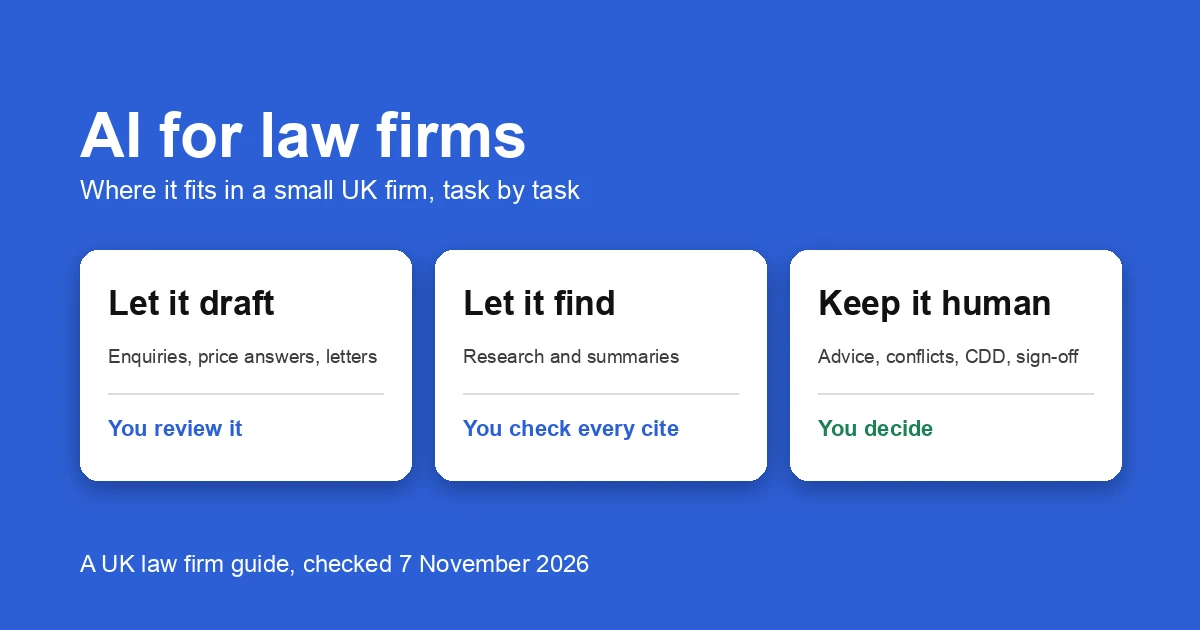
AI can take real work off a small UK law firm in 2026. It can answer website enquiries out of hours, give a labelled price range from your own published fees, and draft letters, summaries and first-draft documents. What it can't take is responsibility for any of it. Advice, the conflict check, client due diligence and anything you sign or file stay with a solicitor. Client information stays out of public AI tools.
That is the SRA's position too. Its August 2026 warning notice on the misuse of AI says AI "has no separate legal personality", and solicitors remain accountable for their work "regardless of how that work has been prepared". This guide takes each task in turn: what AI can do, what stays with you, and the main risk. It puts most weight on the task the results page skips: answering enquiries and price questions on your website under the SRA Transparency Rules. We checked every source on 7 November 2026. This is general information, not legal or regulatory advice.
Key Takeaways
- AI is most useful where the output is a draft a solicitor checks: enquiry replies, price ranges from your published fees, letters, summaries and first-draft documents.
- Advice, the conflict check, client due diligence and sign-off stay with a solicitor. The SRA says you remain accountable "regardless of how that work has been prepared".
- Don't put client information into public AI tools. The SRA warns this will likely breach confidentiality and may waive legal professional privilege for good.
- Check every citation against an authoritative source. In Ayinde (June 2025) the Divisional Court (High Court) said freely available tools such as ChatGPT "are not capable of conducting reliable legal research".
- If you offer an online quote generator, SRA guidance says it must give the quote without requiring "any additional contact at that stage".
AI in a small law firm at a glance
Across six areas of a small firm's work, the pattern is the same: AI produces the first draft or the first find, and a solicitor decides.
| Task | What AI can do | What stays with a solicitor | Main risk |
|---|---|---|---|
| Website enquiries and price questions | Answers questions about your services, asks scoping questions, gives a labelled range from your published fees | Legal advice, taking the client on, the final fee | A chat answer read as advice or as a fixed price |
| Onboarding and client care letters | Drafts the client care letter and welcome email from your templates | The conflict check, client due diligence, scope and cost information | A letter that doesn't match the matter |
| Legal research and court documents | Finds and summarises material, suggests lines of argument | Every authority and citation, and what goes before the court | Invented cases and quotations |
| Drafting and correspondence | First drafts of letters, emails and standard documents | The advice and anything you sign | Client details pasted into a public tool |
| Document and contract review | Flags clauses, compares against your playbook, summarises bundles | The judgement on what matters and what to tell the client | Missed points, and privilege put at risk |
| Meeting notes and summaries | Drafts attendance notes and action lists | Checking the note is accurate before it goes on file | A wrong note becomes the record |
What the SRA, the Law Society, the courts and the ICO say
None of them bans AI. They make you answerable for it, and they set limits on client data.
The SRA Code of Conduct
The Code of Conduct for Solicitors, RELs, RFLs and RSLs (version in effect from 11 April 2025) has no AI rule. Its existing duties do the work:
- Competence. The service you provide must be "competent and delivered in a timely manner" (paragraph 3.2), and you keep your skills up to date (3.3).
- Supervision. If you supervise others, you "remain accountable for the work carried out through them" and must supervise it effectively (3.5).
- Confidentiality. You keep clients' affairs confidential unless disclosure is required or permitted by law or the client consents (6.3).
- Not misleading anyone. You don't mislead your clients, the court or others (1.4), and anything you put to the court must be "properly arguable" (2.4).
- Price information. Clients get "the best possible information" about pricing and likely overall cost (8.7), and your publicity, including about charges, is "accurate and not misleading" (8.8).
The SRA's warning notice, August 2026
On 17 August 2026 the SRA published a warning notice on the misuse of AI, relevant to "all firms and individuals we regulate". It names two concerns: false citations in court documents, and client information entered into public AI tools. Three points matter most for a small firm:
- Accountability. Using AI "does not diminish or transfer your professional responsibilities". Supervisors may breach the Code if false citations reach a court without adequate review (paragraphs 3.5 and 3.6).
- Paid tools aren't automatically safe. The notice says "Both free to use and paid for AI systems may pose risks to client confidentiality", depending on the provider's terms, settings and architecture.
- Where client data can go. Only into systems with proper contractual, technical and organisational safeguards. Firms should check that client data stays in a secure environment, isn't used to train AI models unless explicitly authorised, and isn't kept longer than necessary.
If you fail to have proper regard to the notice, the SRA says, "you are at risk of disciplinary action".
The SRA's Risk Outlook and its first AI firm
The SRA's Risk Outlook report on AI (20 November 2023) is more encouraging. It says "The risk to firms might not come from adopting AI, but from failing to do so." It also gives the line most relevant to website chat: "if you use a third party chatbot to provide initial legal advice, you remain responsible for any errors in that advice." It suggests you "Tell clients when you will be using AI with their case, and how it will operate."
On 6 May 2025 the SRA authorised Garfield.Law, which it calls the first law firm "providing legal services through artificial intelligence". It helps businesses recover unpaid debts through the small claims process. The conditions are telling. The SRA says the system "will not be able to propose relevant case law". The firm must have processes to quality-check work and keep client information confidential. And the system "will only take a step where the client has approved it". Named solicitors stay accountable.
The Law Society
The Law Society's Generative AI: the essentials (updated 30 June 2026) is written for small and medium-sized firms. Its advice on public tools is blunt: if you use a free online service "where you have no operational relationship with the vendor other than use, do not put any confidential data into the tool." It also says you should "carefully factcheck" output, do supplier due diligence, and give staff protocols on using AI. On telling clients, the guide notes that the SRA has no specific guidance on disclosing AI use. It advises agreeing with clients whether and how AI tools will be used.
The courts
In Ayinde v Haringey and Al-Haroun v Qatar National Bank [2025] EWHC 1383 (Admin), handed down on 6 June 2025, the court said freely available tools such as ChatGPT "are not capable of conducting reliable legal research". Lawyers who use them have a duty to check the research against authoritative sources first. In Al-Haroun, 18 of 45 citations put before the court referred to cases that did not exist. The court also said "A lawyer is not entitled to rely on their lay client for the accuracy of citations". Solicitors in both cases were referred to the SRA. The court called on managing partners, among others, to take "practical and effective measures".
The ICO
The ICO's guidance on AI and data protection says "In the vast majority of cases", using AI involves processing likely to be high risk. So a data protection impact assessment (DPIA) is usually required, and if you decide one isn't, you record why. In the ICO's example of firms using a provider's AI tools, "The clients will be controllers, and the provider is likely to be a processor." For your firm, that usually makes you the controller. The ICO notes this guidance is under review after the Data (Use and Access) Act 2025.
Client enquiries and price questions on your website
This is a lower-risk place to start, because the facts the assistant uses are your own: your services, your published prices and your process. The enquirer's details still need your privacy notice and DPIA.
What AI can do. A chat assistant can answer questions about your services at 9pm. It can ask the questions you would ask before quoting and give a range from your own published fees. That sits alongside a duty you already have. Under the SRA Transparency Rules, a firm that publishes the availability of certain services must publish cost information for them on its website (rule 1.1).
For individuals, the list covers six services: residential conveyancing, uncontested probate, immigration applications (excluding asylum), First-tier Tribunal immigration appeals, summary-only motoring offences, and employment tribunal claims for unfair or wrongful dismissal (rule 1.3). For businesses, it covers three: defending employment tribunal claims, debt recovery up to £100,000, and premises licence applications (rule 1.4). The cost information includes the total cost or, where that isn't practicable, the average cost or a range, the basis for your charges, likely disbursements and VAT (rule 1.5). For what each listed service must show, with examples, see SRA price transparency rules.
The SRA's guidance on transparency in price and service (updated 30 September 2024) speaks directly to tools that work out a price:
- "If you offer an online quote generator, this must produce a quote without requiring any additional contact at that stage." The guidance's example is a quote that depends on someone from the firm calling the enquirer first.
- When people use a price generator, research shows they "do not like being forced to provide personal information such as email addresses or phone numbers".
- You must also handle enquirers' data in line with data protection law.
What stays with you. Legal advice, taking the client on and the final fee. Set the assistant to answer questions about your services and prices, and to pass anything about the enquirer's own legal position to a solicitor. The Risk Outlook is clear that if a chatbot gives initial legal advice, you remain responsible for its errors.
The risk. A chat figure read as a fixed price, or a chat answer read as advice. Label every figure in the same message, say what it includes and excludes, and keep your published price page as the reference. A chat assistant doesn't replace the cost information rule 1.1 requires. For when a website chatbot should give prices at all, see should your website chatbot give prices.
A worked example: a conveyancing price question
This example is illustrative. The firm and its fee are fictional; the Land Registry fee is real.
A visitor asks at 9pm what a freehold purchase at £285,000, with a mortgage, would cost. The SRA's guidance suggests questions a conveyancing quote calculator could ask: property value, freehold or leasehold, new build, mortgage, first-time buyer and so on. The assistant asks the ones the firm's fee depends on, then replies:
For a freehold purchase at £285,000 with a mortgage, our fixed fee is £1,050 plus VAT of £210, so £1,260. Likely disbursements are the Land Registry fee of £150 and a search pack of about £300 including VAT. That makes about £1,710 in total. Stamp Duty Land Tax isn't included; you can work it out with HMRC's calculator. This is a guide from our published prices, not a quote. We'll confirm it in writing once we've checked the details and run our conflict and ID checks.
Here's how each figure is built:
| Item | Amount | Where it comes from |
|---|---|---|
| Legal fee | £1,050 | The fictional firm's published fixed fee for this price band |
| VAT on the fee (20%) | £210 | Stated, as rule 1.5 requires |
| Land Registry fee | £150 | HM Land Registry Scale 1, £200,001 to £500,000, transfer of whole title by portal (in effect since 9 December 2024) |
| Search pack | about £300 | The fictional firm's own estimate, including VAT |
| Total shown | about £1,710 | Excluding Stamp Duty Land Tax |
Three things make this reply safer. The figure arrives before any request for contact details. Stamp Duty isn't estimated: the SRA's guidance suggests linking a trusted calculator such as HMRC's instead. And the label sits in the same message as the figure. For how conveyancing quotes are built and compared, see conveyancing quotes.
Where ChatQuote fits
We make ChatQuote. It handles website enquiries and quotes only, not legal advice, research, conflict checks or client due diligence. It answers enquiries on your website from your briefing and documents and asks your scoping questions. If you switch ballparks on, it gives a non-binding range from your own rates. It then drafts an itemised quote and proposal that wait for your approval before they are sent, unless you switch on automatic sending. It is a conversation that collects the enquirer's details, not the no-contact quote generator the SRA's guidance describes, so keep your published price information as it is. Its database is hosted in London; some processing, including the AI models, happens outside the UK. See a website chatbot that gives a price.
Onboarding: conflicts, client due diligence and client care letters
What AI can do. Turn the details from an enquiry and your standard terms into a first-draft client care letter, a welcome email and a list of documents to request. Working from your own templates makes the draft easier to check.
What stays with you. Three checks that no AI tool can sign off:
- Conflicts. You don't act where there is a conflict, or a significant risk of one, between clients, except in the narrow cases paragraph 6.2 of the Code allows. Nor do you act against a former client whose confidential information is material, without effective measures or their informed consent (6.5). A tool can search your matter list; a solicitor decides.
- Client due diligence. The Money Laundering Regulations 2017 require you to identify the client, verify their identity and assess the purpose of the relationship (regulation 28). As a rule, you verify identity before the business relationship is established (regulation 30). An ID-checking tool can help, but the risk assessment and the decision stay with you.
- The client care letter. The scope, the cost information under paragraph 8.7 and the complaints information. The SRA's client care letters guidance (2019) has a checklist: the work agreed, a clear cost breakdown, timescales and a named contact. Our general letter of engagement template explains why it isn't built for solicitors.
The risk. A letter whose scope or fee doesn't match what you discussed. Read the scope and cost sections against your notes line by line before sending. If you use AI on the matter, this is also where the Law Society suggests agreeing it with the client.
Legal research and court documents
What AI can do. Find and summarise material, and suggest lines of argument to test. Legal publishers now build AI into their research tools. LexisNexis, for example, describes Lexis+ with Protégé as "generative legal AI" covering research, drafting and checking legal citations.
What stays with you. Every authority and every quotation. The court in Ayinde listed authoritative sources to check against: the government's legislation database, the National Archives database of judgments, the official Law Reports and the databases of reputable legal publishers. Under the SRA's warning notice, any named authority you rely on should be genuine and relevant, with a verifiable citation.
The risk. Invented or misquoted cases. The SRA notice says relying on AI output "would not be a suitable defence". The Law Society's guide reports a further referral: in April 2026, two solicitors in Rodney v Gee'z Micro Bar & Pitstop were referred to the SRA over inaccurate AI-assisted citations.
Drafting and correspondence
What AI can do. First drafts: client update letters, emails, a plain-English explanation of a process, a first version of a standard document from your precedent. The Law Society's guide lists "drafting or summarising documentation" among the ways firms use generative AI.
Meeting notes and summaries sit here too. Check the note is accurate before it goes on file, because a wrong note becomes the record. Any recording or transcription tool needs a processor contract and a DPIA.
What stays with you. The advice in the letter and anything you sign. Read every draft as if a trainee wrote it. The court in Ayinde drew the same comparison: relying on AI is no different from relying on the work of a trainee solicitor.
The risk. Client details pasted into a public tool to get a better draft. Describe the situation without names, or use a tool your firm has approved for client data under a processor contract.
Document and contract review
What AI can do. Flag clauses, compare a contract against your playbook and summarise a bundle. Luminance, for example, says it helps teams "review faster, negotiate stronger". Harvey describes its platform as "One platform for all legal AI work". Naming them isn't a recommendation; check any tool against the questions below.
What stays with you. What matters in the document, and what you tell the client. If you can't say why a tool flagged a clause, treat the flag as a prompt to look, not a finding.
The risk. Privilege and confidentiality. The SRA's notice cites an Upper Tribunal decision, UK v Secretary of State for the Home Department [2026] UKUT 81 (IAC). The tribunal said putting client letters into an open AI tool such as ChatGPT places them "on the internet in the public domain". The SRA adds that privilege "may be permanently waived". Article 28 of the UK GDPR also requires a written contract with any processor (legislation.gov.uk). Read the provider's data terms before you upload a bundle.
Questions to ask before you switch an AI tool on
Put these to the provider, and keep the answers with your DPIA.
- Where is the data stored and processed? Name the countries, including where the AI model runs.
- Does it train on your inputs? The SRA expects client data not to be used to train models unless explicitly authorised. Get it in the terms.
- Is there a processor contract? Article 28 terms, a list of sub-processors, and who can access your data.
- How long is data kept, and can you delete it? Including chat transcripts and uploaded documents, and on exit.
- What does it do with citations? Whether each authority links to its source, and whether it can invent one.
- Who reviews output before it reaches a client or a court? Whether anything is sent automatically, and whether you can turn that off.
- For a website tool, when does it show a price? Whether it gives the figure before asking for contact details, and whether it labels every figure.
- Have you updated your own paperwork? Privacy notice, client care letter wording, a staff policy on approved tools, supervision of staff using them, and a word with your professional indemnity insurer.
Frequently asked questions
Can solicitors use ChatGPT?
Yes, but not with client information in a public version. The SRA warns that putting client information into public AI tools risks breaching confidentiality, and the Law Society says not to put confidential data into free tools at all. Business and enterprise versions of general AI assistants can offer terms that exclude training on your inputs and a processor contract. Check them against the eight questions above before approving one, and check every legal point against an authoritative source.
Do I have to tell clients I use AI?
There's no SRA rule that sets a form of words. The SRA's 2023 Risk Outlook suggests telling clients when you will use AI on their case and how it will operate. The Law Society advises agreeing with clients whether and how AI tools will be used. The client care letter is the natural place to do it.
Can a chatbot on my website give legal advice?
It can, but you answer for it. The SRA says that if a third-party chatbot gives initial legal advice, "you remain responsible for any errors in that advice". Most small firms keep chat to services, prices and next steps, and pass questions about the enquirer's own position to a solicitor.
Will AI replace lawyers?
None of the regulators or courts cited here suggests it. Even Garfield.Law, the first firm the SRA authorised to deliver services through AI, has limits. It can't propose case law, acts only with the client's approval at each step, and has named solicitors who stay accountable.
Your next step
Start where the information is your own: website enquiries and price questions, then letters and drafting. Run the eight questions above for each tool, write down who reviews what, and keep client information out of public AI tools. For the same task-by-task view for accountancy practices, see AI for accountants.
If you'd like your website to answer enquiries and draft quotes for your review, ChatQuote has a 30-day free trial, and no card is needed.
About this article
Written by the ChatQuote team at CodeLeap Ltd, the company that makes ChatQuote. Sources are the SRA Standards and Regulations (Code of Conduct and Transparency Rules, version in effect from 11 April 2025), SRA guidance, the SRA warning notice of 17 August 2026, the SRA Risk Outlook on AI and its Garfield.Law announcement, the Law Society's generative AI guide, the Ayinde judgment, ICO guidance, HM Land Registry, and legislation.gov.uk. All were checked on 7 November 2026. Product descriptions for LexisNexis, Luminance and Harvey are taken from their own pages on that date. The conveyancing example uses a fictional firm and fee.
This is general information for law firms in England and Wales, not legal, regulatory or data protection advice. Spotted something out of date? Email support@chatquote.app.